
(including
reports
©
NASA and
©
Spaceweather.com
and information from the Royal Astronomical Society)
Updated: 18 October 2024
Note: some links on this page will have expired, as the news is no longer topical. Some remain active for only a couple of days. Stories from Spaceweather.com are changed every day - ensure you have the Dateline date in the Archives calendar at upper right of the Spaceweather home page for any story. Stories from previous days can also be accessed through the Archives calendar. Simply enter the month, day and year as shown in the Dateline of the required story.
If a link does not open, it may be because your browser is blocking pop-ups. If so, a message to that effect will appear on the screen. To open the link, left-click on it while holding down the Ctrl key.
Note: Some parts of this webpage may be formatted incorrectly by Google Chrome.
Interesting research news (latest news first):
The Australian
National University has joined the Giant Magellan Telescope international consortium of research organisations. The
GMT is likely to be one of the first of a small number of next-generation
Extremely Large Telescopes that are expected to be built in the next 20 years.
The telescope's conceptual design anticipates a moving mass of 1000 tonnes and a
cylindrical observatory 65 metres high. It will be built by the participating
organisations at a site in northern Chile. The primary mirror will have seven
circular segments each 8.4 metres across, six of these surrounding the centrally
located seventh. The total light-gathering power will be nearly seven times that
of the
Gemini telescopes,
which are the largest ones to which Australian astronomers currently have access, and the images obtained should be ten times
clearer than those taken with the
Hubble Space
Telescope. The GMT is expected to see first light in
2022. GMT Home page Australia's involvement
NASA's
powerful infrared Spitzer Space Telescope
has taken an image that rivals the
Hubble Space Telescope's 'Pillars of Creation' photograph taken ten years ago of
part of the Eagle Nebula. Dubbed the 'Mountains of Creation', it shows huge
clouds of matter undergoing intense star formation in the region W5 in
Cassiopeia. These clouds, which are ten times bigger than the Pillars, are
illuminated in the infrared band, but appear as dark clouds in visible light
images. Full
story
ESA's Smart-1 spacecraft
The Chandra X-ray Observatory
The Rosetta space
vehicle
The
newly-discovered planetoid Sedna
The
ESA solar spacecraft Ulysses
The
Chandra X-ray Observatory
NASA's
Genesis spacecraft
The Hubble Space Telescope
Latest Astronomical Headlines from the IAU (International Astronomical Union):
Click here.
New Comets:
Comet 12P Pons-Brooks

Click here for a pdf copy of this illustrated 48-page report.
If you can't find it, it may have gone to your Downloads folder.
The launch of the fifth Starship flight test took place on June 6 last. Check the SpaceX website for a full report with videos.
It used Super Heavy Booster 11 and Starship 29. Apart from minor damage to the Starship's flaps due to the heat of re-entry, the test was very successful. Both vehicles made soft landings in water, the Booster in the Gulf of Mexico and the Starship in the Indian Ocean. The sixth test flight is scheduled for this month. It is possible that the Booster may land on a drone ship, a feat that is routine for Falcon Heavy Boosters, but not yet tried with a Super Heavy Booster. This will require the Booster to be fitted with landing legs, and the drone ship will need to be much larger.
The original intention was for the Boosters and Starships to return to their
launch site at Starbase in Texas, but this will require the vehicles to have
additional fuel capacity. When they reach Starbase, they will descend vertically
at the launch tower and will be captured by the "Mechazilla" arms without
touching down.
Click here for a comprehensive report on the 18 November 2023 launch of Starship 25
|
|
UNIVERSE TODAY |
|
NASA NEWS
|
|
SPACEX NEWS
|
Dateline - 30 June 2023 - Virgin Galactic launches its first commercial mission to suborbital space, carrying two pilots and four passengers
Virgin Galactic's method of travelling to the threshold of space is to use a mothership which looks like a regular jet plane except that it has two widely-spaced fuselages attached to its large wing. The fuselages are identical, with a pilot's cockpit up front and a tailplane at the rear. The one used today for the first commercial spaceflight (Galactic 01) is called VMS Eve (VMS = Virgin MotherShip). Attached to the centre of the wing between the two fuselages was the SpaceShipTwo spaceplane called VSS Unity (VSS = Virgin SpaceShip). The flight began in the early hours of this morning (Australian Eastern Standard Time) from Spaceport America in New Mexico. The mothership took off and climbed to an altitude of 15 kilometres and a speed of 550 kilometres per hour. At that point the VSS Unity was released, and fell away from the mothership, which returned to Spaceport America. The spaceplane then fired its rocket motor, and accelerated to Mach 1 (the speed of sound). It turned upwards and climbed vertically, continuing to accelerate past Machs 2 and 3. At an altitude of about 100 kilometres, the rocket motor was shut down and the crew experienced weightless conditions. The configuration of the wings was made vertical for re-entry, and the crew experienced forces up to 6G as the craft decelrated. When the speed had dropped considerably, the wings were returned to a horizontal configuration and the craft acted like a glider. After a flight of 90 minutes, the spaceplane landed back at Spaceport America. The flight was a complete success. Click here for a video of most of the flight.

Dateline - 12 May 2023 - SpaceX Starship plus Super Heavy Booster suffers catastrophic failure at first launch attempt
The SpaceX Starship orbital test flight (officially the Starship Flight Test was the first flight of the Starship launch vehicle from Starbase at Boca Chica Base at the most southerly point in Texas. . The main aim of the test was to see how well the two stages operated together. With a test such as this, success is measured by how much can be learned to inform and improve the probability of success in the future as SpaceX rapidly advances the development of Starship. This two-stage rocket configuration is known by SpaceX as ‘the Full Stack’ or 'Starship' for short. It can lift a payload of 150 tonnes if the Super Heavy booster is to be re-used, sometimes up to 250 tonnes if the booster is to be expendable. Like all previous Starship launches, there were no crew members on board, and of course the boosters cannot carry crew.
The flight vehicles – Super Heavy Booster 7 and Starship 24 – were stacked on the Orbital Launch Mount on 6 April 2023, and on 15 April the Federal Aviation Administration (FAA) gave flight approval, which ensured that the rocket’s flight path was free of other aerial traffic. For the first flight of the combined Starship + Super Heavy booster on 20 April 2023, no vertical landing of either stage was planned. Just prior to lift-off, three of the 33 Raptor engines in the booster indicated "non-nominal functions" and were shut down. At T+85 seconds the hydraulic power units providing thrust-vectoring control failed, possibly due to damage by chunks of concrete as big as cannon balls blasted up from the Orbital Launch Mount’s base (made of heat-resistant concrete called Fondag, which had a huge hole blown in it by the force of the engines. Unfortunately, a massive water-cooled steel base had not been ready in time for this launch.
Much damage was caused to infrastructure, with sheds and fuel tanks dented, and rubble scattered over 385 acres. Large pieces of concrete splashed into the ocean half a kilometre away, and fragments fell on the town of Port Isabel 6.5 km to the north, where windows were smashed, possibly by the arrival of shock and pressure waves. As the rocket gained speed (2150 km / hour) and altitude (39 km), more engines died. It became unstable, turning, tumbling, gyrating and falling. Four minutes into the flight, the FTS (Flight Termination System) failed, preventing a safe separation of the stages. Technicians manually aborted the mission in what they called a "rapid unscheduled disassembly" (explosion). The debris fell 29 km into the sea.
CEO Elon Musk said, “We learned a lot,” (from this failure). The Orbital Launch Mount (OLM) may need to be modified to include a water deluge and flame trench. The next test flight of an integrated Super Heavy + Starship rocket will take place “in a few months” from the same Starbase Launch Pad. Repairs to the damage caused are proceeding rapidly. Click
here for a video of the failed launch.
Dateline - 15 April 2023 - SpaceX Starship plus Super Heavy Booster set to launch next week
On April 17 the Starship + Super Heavy Booster will have its first flight. Launched from Starbase in the southrn-most part of Texas near the Mexican border, the rocket will be the first to fly in this configuration. The Booster will have a "water landing" in the Gulf of Mexico, while the Starship second stage will cross Africa and the Pacific Ocean to a "water landing" near Honolulu. For reasons not available, it is possible that neither of these "landings" will be onto drone ships as has been done in the past, and the two vehicles might not be recovered. There may be unforeseen delays altering the date of the flight. Click on the SpaceX button above to find updates and to watch the whole mission.
Dateline - 21 November 2022 - Artemis I Orion spacecraft will fly close to the Moon tonight
Tonight, November 21, the Artemis / Orion unmanned spacecraft will make its closest approach to the Moon in a flyby, coming within 100 kilometres of the lunar surface as it prepares to enter a wide, looping orbit, called a "Distant Retrograde Orbit" (DRO). NASA will webcast the Moon flyby live, beginning at 10:15 pm Australian Eastern Standard Time. The time of closest approach is scheduled for 10:57 pm our time. Orion will enter its final orbit around the Moon on Saturday, November 26 at 7:52 am AEST (our time), with NASA coverage beginning at 7:30 am AEST. You can watch NASA's Artemis I Orion webcasts live here .
Dateline - 19 November 2022 - Artenis I / Orion moon rocket more than halfway to the Moon after successful launch
Here is the mission profile for the Orion spacecraft now heading for the Moon on a 25 day voyage. There are no living persons on board, just three test mannikins, named Commander Moonikin Campos, Helga and Zohar. There are two soft toys on board, of Charlie Brown's dog Snoopy for NASA, and Shaun the Sheep for ESA (European Space Agency, who built Orion). The spacecraft is today at #4 below, coasting along and losing speed due to the Earth's gravity pulling it back. Yesterday its speed fell below 3000 kilometres per hour. Soon, as it nears the Moon, the lunar gravity will overcome the pull of the Earth, and Orion will pick up speed, prior to flying around the Moon ( #5 ) and using its engine to insert into a distant retrograde orbit ( #6, #7 and #8).
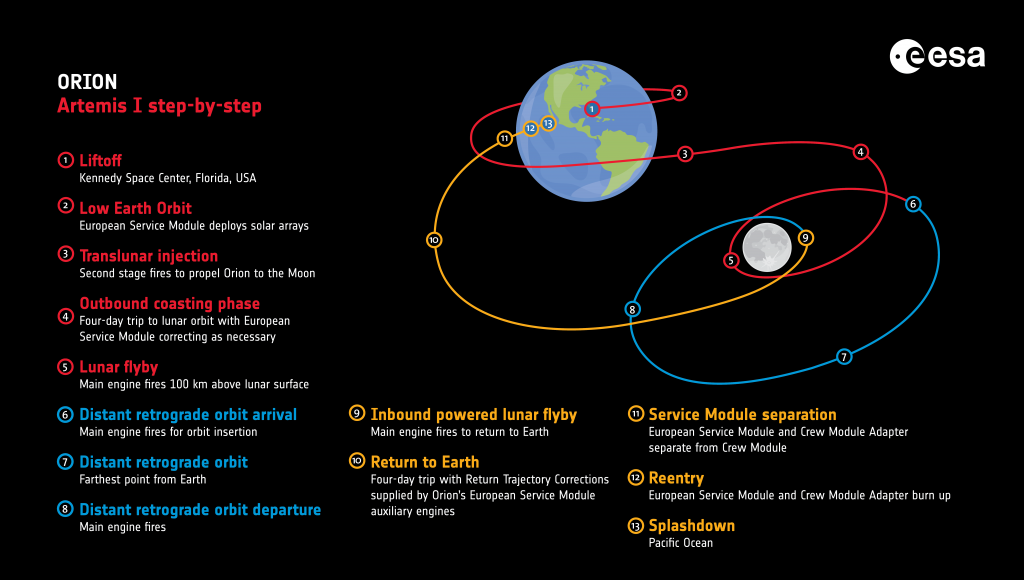
(Copyright NASA / ESA)
Dateline - 15 November 2022 - NASA rocket scheduled to take off for the
Moon tomorrow afternoon
NASA's long-awaited return to the Moon may come one step closer next week if the launch tomorrow of the Artemis 1 rocket is successful. Recent scheduled launches had to be abandoned due to mechanical problems in two instances and arrival of Hurricane Ian in a third attempt. Tomorrow's launch was in doubt with the arrival of Hurricane Nicole last week, but it now appears to be going ahead, with the actual lift-off occurring on or about 3:30 pm (updated) on the afternoon of November 16. At the Kennedy Space Center in Florida, the time will be 1:04 am, allowing us to see a spectacular night-time launch. It is possible that there might be unforeseen delays. Click here and here for more. Watch the countdown live here .
Dateline - 8 September 2022 - Perseverance surprise
discoveries inside Jezero Crater on Mars
Early findings by Perseverance rover are found here .
Dateline - 2 September 2022 - NASA rocket scheduled to take off for the
Moon tonight
Dateline - 14 July 2022 - How the James Webb Space Telescope can detect elements present in exoplanets and distant galaxies
The use of spectroscopy to identify different elements far off in space has been known for nearly two centuries, but the JWST has taken this process to the edge of the known universe, and back 13.1 billion years almost to the Big Bang itself. Click here for more.
Dateline - 12 July 2022 - First pictures from the James Webb Space Telescope released
On July 12 a suite of six images from the JWST was released. Click here for the NASA press release.
Dateline - 22 June 2022 - How scientists study wind on Mars
Dust devils on Mars have been known for some time. They are now being carefully studied. Click here for the latest NASA report.
Dateline - 5 August 2021 - The space probe Juno celebrates ten years in space
On August 5, 2011, the space probe Juno was launched on its mission to Jupiter. It took five years to get there, arriving in Jupiter space in August 2016. Since then it has discovered more of Jupiter's moons, of which there are now 79 known, 53 being named. Earlier this year, NASA extended Juno's mission to September 2025, to allow it to investigate the whole Jovian system, including the faint rings. C lick here to see some of Juno's images.
Dateline - 3 July 2021 - Virgin Galactic announces the first fully-crewed flight of its SpaceShipTwo Unity will go into space this month
Virgin Galactic has announced that the flight window for the next rocket-powered test flight of its SpaceShipTwo Unity opens July 11, pending weather and technical checks. The “Unity 22” mission will be the 22nd flight test for VSS Unity, and Virgin Galactic’s fourth crewed spaceflight. It will also be the first to carry a full crew of two pilots and four mission specialists in the cabin, including Virgin Group Founder Richard Branson, who will be testing out the private astronaut experience. For the first time, Virgin Galactic will livestream the test flight for everyone to watch from home. The livestream will be available to watch here , and is expected to begin at 11:00 pm Australian Eastern Standard Time on the day of the flight. For more, click
here .
Dateline - 29 April 2021 - Apollo 11 astronaut Michael Collins dies aged 90
Michael Collins was the third member of the Apollo 11 crew who flew the Command Module Columbia around the Moon in July 1969 while Neil Armstrong and Buzz Aldrin descended to the lunar surface in the Lunar Module Eagle. In the 24 hours that Armstrong and Aldrin were working at Tranquillity Base, Collins completed 30 orbits of the Moon alone in Columbia. After the safe return of the crew to Earth, Collins was offered a job by President Nixon to be the head of the State Department's Bureau of Public Affairs. He resigned from NASA and never flew in space again. He later held high positions as Director of the National Air and Space Museum and as Undersecretary of the Smithsonian Institution. He received many honours and awards, and wrote four books about space travel. Widowed in 2014, he passed away peacefully in Florida on 28 April 2021 after a battle with cancer. His family was by his bedside. Neil Armstrong died in 2012. Buzz Aldrin, the last surviving member of the Apollo 11 crew, is still with us aged 91.
Dateline - 21 April 2021 - NASA's Ingenuity Mars helicopter successfully makes its first test flight
On April 19, 2021, NASA's Ingenuity Mars Helicopter made its first test flight, in which it lifted off from the Martian surface and hovered, before setting down again. See the video here .
Dateline - 3 April 2021 - NASA's Ingenuity Mars helicopter prepares for its first flight
NASA's Mars rover Perseverance is currently in transit to the 'airfield' where the rotorcopter Ingenuity will attempt a test flight. At present, Ingenuity remains bolted to the underside of the rover, and will be lowered to the ground when the rover reaches a 10 metre square 'helipad' chosen as it is level and free from rocks. The helicopter deployment process will take about six sols (a 'sol' is a Martian day, which is about 40 minutes longer than a day on Earth). On the sixth sol, Ingenuity will be lowered to the Martian surface and Perseverance will drive about 5 metres away to photograph the test flights. The deployment is now underway and the first flight is scheduled for no sooner than April 11. Click here
and here to see more details. NASA has also placed some relevant videos on Youtube. They are available here .
Dateline - 2 April 2021 - The International Space Station transits a 'Mineral Moon'
On March 26 Moldovian astrophotographer Alexandru Barbovschi filmed a split-second transit of the ISS across the face of the almost Full Moon. He then photographed the Moon through coloured filters which revealed the minerals that are present on its surface. Visit Spaceweather to see the beautiful pictures he acquired.
Dateline - 26 March 2021 - Looking for Venus ?
Don't. Today Venus is at superior conjunction, extremely close to the Sun's limb (edge) and dangerous to observe. It will become visible in the western twilight sky towards the end of May, and by July will be the brightest object in the night sky apart from the Moon.
Dateline - 10 March 2021 - Flashes in the night sky
Now you see it, now you don't. A flash of light briefly appears in the night sky, then disappears before you can make out what it is. No, it's not your imagination. It's a geosynchronous satellite. Matt Penn captured dozens of them glinting in the night sky over Tucson, Arizona on March 6. "This is the season for geosynchronous satellite glints." says Penn. "They tend to occur around the equinoxes. Anyone can see them, as some are as bright as second magnitude." Visit Spaceweather for a video showing the flashes.
Dateline - 23 February 2021 - The view from NASA's Perseverance lander as it descends to the surface of Mars
This video shows the lander's view from parachute deploy to the actual touchdown. Click here to watch.
Then click here for a 360 panoramic view showing the Martian surface all around the lander (use your mouse to move the view around the horizon).
Dateline - 19 February 2021 - NASA's Perseverance lander touches down safely on Mars
This morning the Mars lander Perseverance successfully landed in 49-kilometre diameter Jezero Crater. The site is 18.38 degrees north of Mars' equator at longitude 77.58 degrees East. Jezero crater is on the eastern boundary between the dark area known as Syrtis Major and the lighter area called Isidio Regio. The area is the fan-delta of an ancient river that ran into the crater millions of years ago. At that time the crater was filled with water as a lake. The lander will search for the remains of ancient life-forms that might have existed before the river dried up. The lander is equipped with a small drone called the Ingenuity Mars Helicopter designed to test (for the first time) powered flight in the thin Martian atmosphere. Click here for more.
Dateline - 2 January 2021 - The Earth is at its closest to the Sun today
The Earth's orbit around the Sun is slightly elliptical. This means that the distance of the Earth from the Sun varies each year between 147 099 585 kilometres in the first week of January (perihelion) and 152 096 154 kilometres in the first week of July (aphelion). Also, the angular size of the Sun as seen from Earth varies between 32' 53" in January and 31' 47" in July. The Earth is at its closest to the Sun and it appears slightly bigger in size during Australia's summer, but the effect that this variation has on our summer temperatures is tiny compared with other factors caused by the Earth's axial tilt, ocean temperatures, climate and weather. Visit Spaceweather for more.
Dateline - 22 December 2020 - The great conjunction of Jupiter and Saturn
The last time a conjunction this close happened, the telescope hadn't been invented yet. Last night, however, optics around the world were trained on Jupiter and Saturn as the two planets converged for an 800-year meeting. On December 21, 2020, Jupiter passed by Saturn and they were only 0.1 degrees apart. The two planets came equally close in 1623, but that conjunction was impossible to see from Earth because it occurred when both planets were too close to the glare of the Sun. The last time the two planets were so close together and so easy to see was in the year 1226. Click here for a picture (set the date for December 22).
Dateline - 6 December 2020 - Japan's Hayabusa 2 asteroid sample capsule makes a perfect return to Earth near Coober Pedy, South Australia
The Hayabusa 2 spacecraft left six years ago on a trip to the asteroid Ryugu and back, which ended this morning after travelling for 5.1 billion kilometres. The 40 cm container which held samples from the asteroid parachuted to a safe landing at 4:37 am 320 kilometres south-east of Coober Pedy, in the Woomera Prohibited Area. About an hour later, the capsule was located and picked up by helicopter and taken to a facility. It is expected that there will be about one gram of asteroid material within the capsule's specimen chamber. Click here for more details.
Dateline - 4 December 2020 - Arecibo Radio Telescope collapse captured on video
The collapse of the 900 ton receiver feed platform down 150 metres to the 1000-foot Dish below has been captured on camera. Click here to read the article and watch the video. Click here and scroll down for the official footage of the National Science Foundation (owners of the Arecibo Radio Observatory), which includes earlier scenes of a man walking on the catwalk from a tower out to the receiver feed platform and working there before its collapse. Click here for a frame-by-frame analysis of the official video including footage of the Arecibo Dish before the disaster.
Dateline - 3 December 2020 - Arecibo Radio Telescope suffers a catastrophic collapse and is now in ruins
The Arecibo Radio Telescope is no more. Since our last post immediately below, engineers monitoring the telescope observed that wires in the 16 remaining support cables were breaking at a rate of one or two a day, and reported that the receiving feed platform would soon collapse. At 7:55 am local time on December 1, all the cables in one tower failed, and the 900 ton receiver platform crashed down, creating great damage to the reflecting panels in the 1000 foot Dish below. No-one was close to the Dish at the time. This is the end of the Arecibo Radio Telescope. More information is available here, here and here. Contributed by Lee.
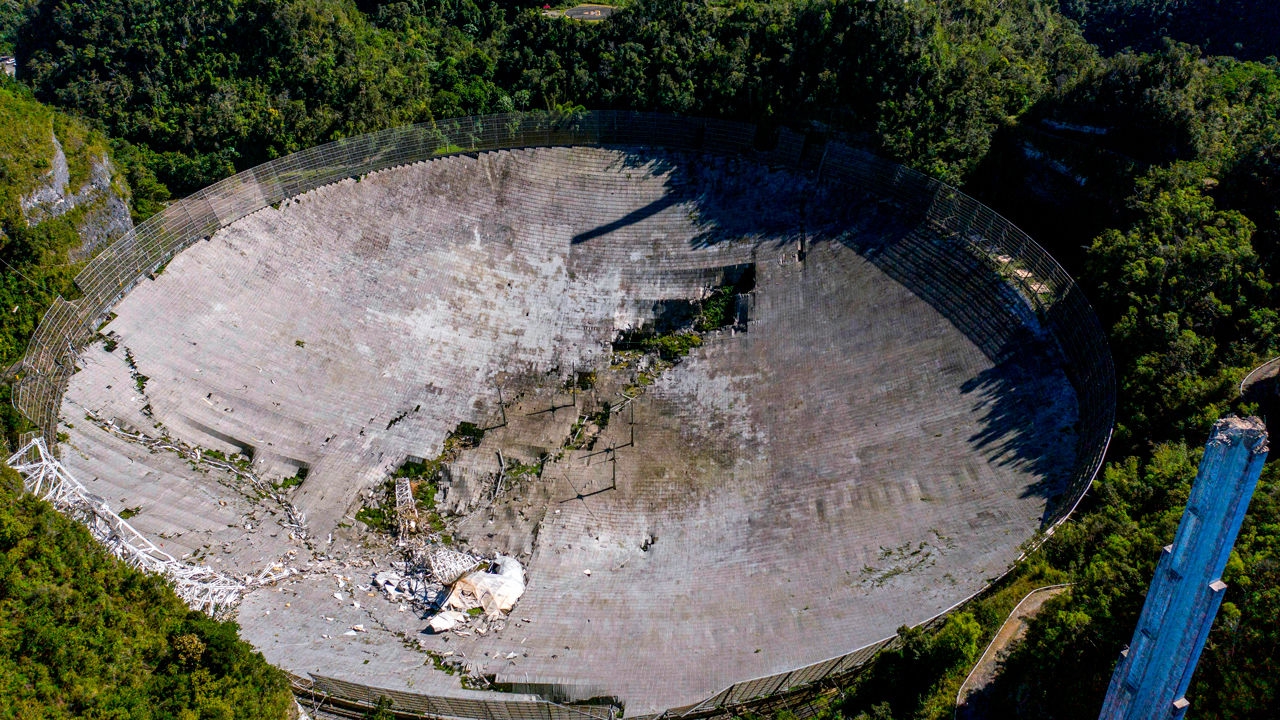
The Arecibo Radio Telescope after the collapse. The remains of the receiver platform are at the lower left. A sheared-off tower is at right.
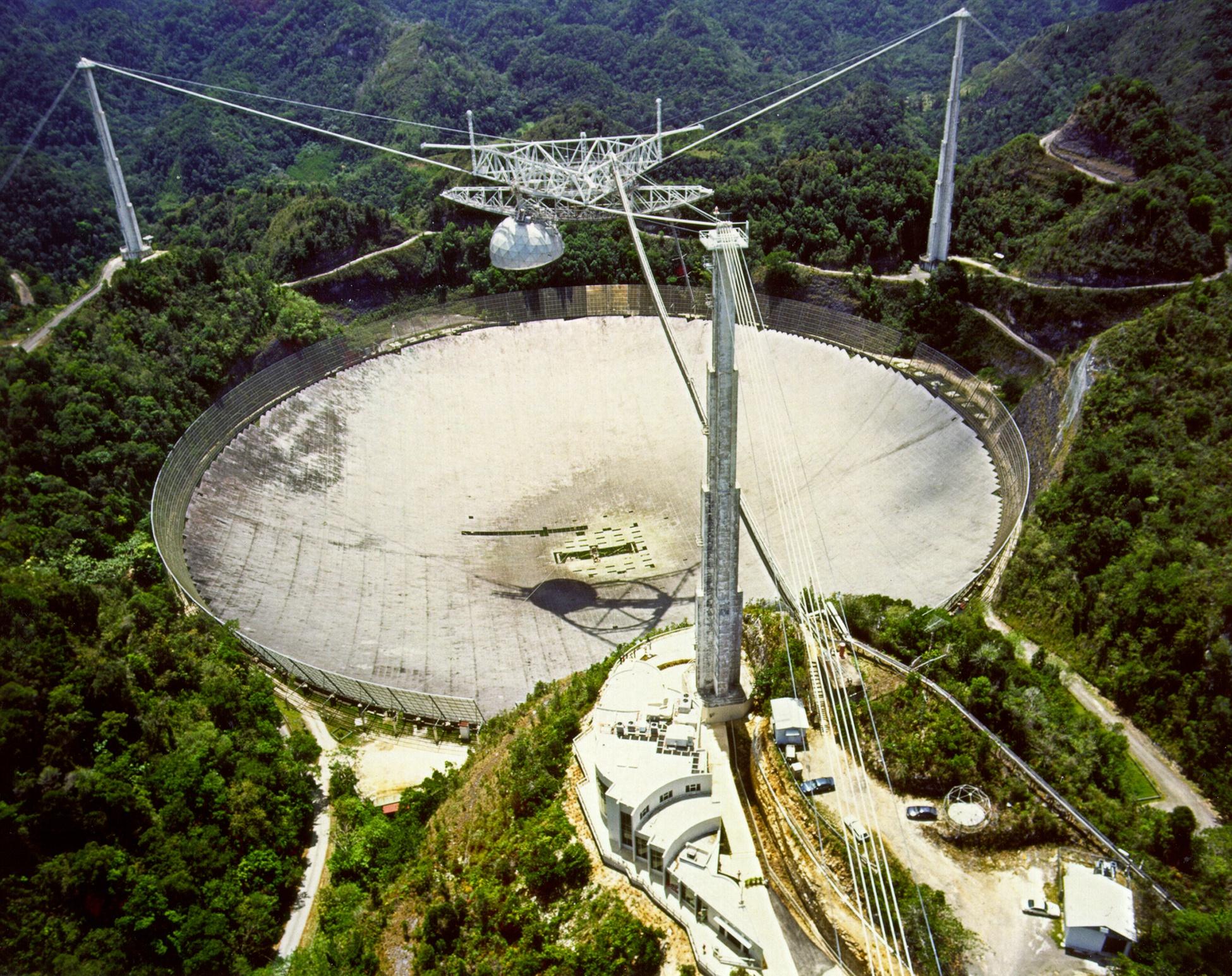
The Arecibo Radio Telescope in its heyday.
Dateline - 20 November 2020 - Arecibo Radio Observatory to be decommissioned due to damage
The famous Arecibo radio telescope is finally closing down. With a dish antenna 305 metres (1000 feet) in diameter built in a crater-like depression in Puerto Rico, it was the largest single radio telescope in the world from its inauguration in 1963 until the commissioning of China's Five hundred metre Aperture Spherical Telescope (FAST) in September 2016. The Arecibo Dish was originally made of wire netting, but later the netting was replaced with fixed aluminium panels. Many upgrades were conducted over the years, and the fixed panels were replaced with adjustable ones. The FAST Dish's panels have been made adjustable from the start. Both radio telescope Dishes reflect incoming radio waves to a receiver platform suspended high above the centre of the Dish on six steel cables from each of three tall concrete towers (or in the case of FAST, six towers). As well as receiving signals from space, the Arecibo Dish had the extra capability of transmitting radar signals into space, and could bounce radar waves off the Moon and planets. In the 1960s it sent messages out to the cosmos in the SETI (Search for Extra-Terrestrial Intelligence) project.
Built in a hurricane-prone area, the Arecibo Dish suffered minor damage from storms in the last decade, and Hurricane Maria in 2017 put its future in doubt. However, it was repaired and continued limited operation. On August 10, 2020, shortly after the passage of Tropical Storm Isaias, a platform support cable detached, and in flailing around, tore a 30 metre gash in the Dish below and damaged the receiver platform and its Gregorian Dome, where radio waves reflected from the Dish below were collected. The facility was closed as damage assessments were made.
Before the broken cable could be replaced, on November 7 last a second cable from the same tower snapped, shattering part of the Dish itself. With the 900 ton receiver platform now being suspended 150 metres above the Dish by six cables from each of two towers, and only by four cables from the third tower, the situation was regarded as dangerous, and on the brink of disaster. The other cables are now under unbalanced stress and may also fail, leading to the catastrophic fall of the receiver platform. This would destroy the Dish and perhaps nearby buildings which have already been evacuated.
The National Science Foundation (NSF) announced yesterday that they have decommissioned the Arecibo telescope and will begin carefully dismantling it in the next few weeks after determining the safest way to do so. This will end its 57-year mission. NSF's Sean Jones stated, "This decision is not an easy one for NSF to make, but safety of people is our number one priority." More information is available here and here .
The Arecibo Radio Telescope features in the James Bond movie GoldenEye and Carl Sagan's movie Contact with Jodie
Foster, the latter also featuring the Karl G. Jansky Very Large Array radio telescope in Socorro, New Mexico, USA.
Dateline - 11 November 2020 - Here comes Comet ATLAS
Comet ATLAS (C/2020 M3) is approaching Earth, and will be at its closest on November 14. It will be 54 million kilometres away, so won't be visible to the unaided eye. Shining at eighth magnitude in the constellation of Orion, it will be close to the star Bellatrix just before midnight on November 15. Sky maps are available at Spaceweather .
Dateline - 9 November 2020 - Northern Taurid fireballs
If you see a fireball (or bolide) this week, it is probably a piece of
Comet 2P/Encke, which is the source of the annual Northern Taurid meteor
shower. Northern Taurids are slow and bright, and they fly out of a patch of
sky near the Pleiades star cluster. The shower will continue for all of this
week. Sky maps are available at
Spaceweather .
Dateline - 24 October 2020 - Dark cloud on Mars
On October 22 a small dark cloud appeared above the Tharsis volcanic plateau on Mars. It does not appear to be connected with any of the five extinct volcanoes in the region. Go to Spaceweather for more details.
Dateline - 19 October 2020 - Meteors from Halley's Comet
The Earth is currently entering a stream of debris from Halley's Comet, source of the annual Orionid meteor shower. The shower will peak on October 21. Visit Spaceweather for a sky map.
Dateline - 4 October 2020 - Close approach of Mars
Earth and Mars are about to have a close encounter, one of the closest since 2003. On Tuesday October 6, Mars will be only 62 million kilometres from Earth. Brighter than all the stars and planets except Venus, it will rise in the east shortly after sunset. A backyard telescope will show plenty of details on the red planet.
Dateline - 15 September 2020 - Solar Cycle 25 has begun
Solar Cycle 25 is officially underway. NASA and NOAA made the announcement during a media teleconference earlier today. According to an international
panel of experts, sunspot counts hit rock bottom in December 2019, and have been slowly increasing since. What can you expect in the months ahead? Visit
Spaceweather for answers.
Dateline - 9 September 2020 - Mars begins its retrograde S-bend
Today, Mars stopped moving among the stars, reversed course, and started going the other way. Astronomers call this "retrograde motion," and it's a
sign that Earth and Mars are about to have a close encounter. Get the full story with sky maps and observing tips on
Spaceweather .
Dateline - 27 August 2020 - The Sun is swallowing a comet
A comet discovered just yesterday is diving into the Sun. As you might
expect, it's not going well for the comet. Cameras on the Solar and
Heliospheric Observatory (SOHO) are recording the comet's last moments
now, including the deconstruction of the comet's icy core into a
'boulder-strewn trail'. Visit
Spaceweather
for more information and movies.
Dateline - 14 August 2020 - Why did Betelgeuse suddenly fade last December, and then recover ?
Late last year, the star Betelgeuse suddenly became dim, and by April this year had returned to its normal brightness. Astronomers proposed various theories to explain this unusual phenomenon, such as a dark spot on the star, the passage of a molecular cloud in front of the star, and a possible dimming as a precursor to a supernova explosion. Now observations from the Hubble Space Telescope both before the event and since have revealed that the cause of the dimming was probably a great outburst of matter from Betelgeuse itself. Click here for NASA's press release yesterday, explaining the event.
Dateline - 13 August 2020 - Unusual triple comet flies past the Sun
Astronomers were surprised on August 7 when a triple comet flew past the
sun. Cameras onboard the Solar and Heliospheric Observatory (SOHO) captured
the flyby, which did not fit the usual pattern of comet fragments
dive-bombing our star. Get the full story at
Spaceweather .
Dateline - 7 August 2020 - Perseid Meteor alert
Earth is entering a stream of debris from giant comet 109P/Swift-Tuttle,
source of the annual Perseid meteor shower. Although the display is not
expected to peak until August 11-13, sky watchers are already seeing some of
the most beautiful fireballs of the year. The best time to observe these
meteors is in the hours 3 am to 5 am, looking north-east to north. Plan your Perseid watch with sky
maps and observing tips on today's edition of
Spaceweather .
Dateline - 3 August 2020 - The next solar cycle is beginning
There's no longer any doubt. Solar Cycle 25 is coming to life. A new sunspot emerged today, crackling with flares and adding to a string of new-cycle active regions spread across the face of the Sun. Is the Solar Minimum over? Find out the answer on today's edition of Spaceweather .
Dateline - 22 July 2020 - Comet NEOWISE approaches Earth
Tonight might be your best chance to see Comet NEOWISE for the next
6800 years, for this evening the comet will make its closest approach to
Earth. The fading comet is still visible to the naked eye from dark-sky
sites and an easy target for photographers everywhere. Get the full story at
Spaceweather .
Dateline - 10 July 2020 - Comet NEOWISE has a super-sized nucleus
Now we know why Comet NEOWISE (C/2020 F3) is so bright. It has an
unusually large nucleus. Infrared data from NASA's NEOWISE spacecraft
suggest that the comet's core of ice and dust is 5 kilometres wide. This
bodes well for the comet's visibility in the weeks ahead. Visit today's
edition of
Spaceweather
for the full story and observing tips.
Dateline - 3 July 2020 - Comet NEOWISE has become a bright pre-dawn comet
Today, Comet NEOWISE (C/2020 F3) is passing by the sun near the orbit
of Mercury - and it seems to be thriving. Many astronomers in Europe and the
USA photographed the comet at the crack of dawn shining through bright
twilight. The mornings ahead could be even better, although the comet
favours observers in the northern hemisphere. Visit today's edition of
Spaceweather
for pictures and observing tips.
Dateline - 30 June 2020 - Comet NEOWISE is brightening rapidly
This week, Comet NEOWISE (C/2020 F3) is passing by the Sun and
is rapidly brightening to naked-eye visibility. New images from the Solar
and Heliospheric Observatory (SOHO) satellite show an eight-fold
increase in brightness to second magnitude in just a few days. A movie of
the comet's development is featured on today's edition of
Spaceweather .
It may become visible in mid-July if it leaves the solar glare intact.
Dateline - 20 June 2020 - Solar eclipse this weekend
The Sun is about to turn into a 'ring of fire'. On the
afternoon of June 21, the Moon will pass directly in front of the Sun,
producing an annular solar eclipse over Earth's eastern hemisphere. No part
of this eclipse will be seen from Australia, but movies, timetables, and
links to live webcasts are featured on today's edition of
Spaceweather .
Dateline - 16 June 2020 - New naked-eye Comet
Comet NEOWISE (C/2020 F3) is plunging toward the Sun, and it could
become a naked-eye object in mid-July. The comet's fate will be revealed
early next week when it passes in front of a SOHO coronagraph - just as the
comet is about to experience the most blistering heat from the Sun. Will it
survive, or will it disintegrate and disappear as did Comet ATLAS and Comet SWAN last month? Visit
Spaceweather
for the full story.
Dateline - 2 June 2020 - Inferior conjunction of Venus
Venus looks like a ring of fire! The second planet is
making a close approach to the Sun this week, an event astronomers call
'inferior conjunction'. In fact, it's one of the closest approaches in
decades. Professional astronomers daring enough to observe the event are
capturing rare images of Venus backlit by the Sun. Such work requires
specially-built equipment. Ordinary folk should never look directly at the
Sun with or without a telescope, as severe eye damage may result. Visit
Spaceweather
for the full story.
Dateline - 15 May 2020 - Big sprites and colourful airglow
This week, a colourful "bullseye" formed at the edge of
space above a towering thunderstorm in west Texas. An astronomer at the
McDonald Observatory captured the display, which also featured a ferocious
outburst of sprites. Visit today's edition of
Spaceweather
for a must-see movie and explanations.
Dateline - 6 May 2020 - Comet SWAN erupts with a naked-eye outburst
This week, an outburst from Comet SWAN (C/2020 F8)
surprised observers in the southern hemisphere, who could actually see the
comet brighten with their unaided eyes. SWAN is a fresh comet, and
more outbursts from its newly-sunlit core are possible in the nights ahead.
Visit today's edition of
Spaceweather
for the full story.
Dateline - 4 May 2020 - Eta Aquariids meteors expected to put on a fine display
This meteor shower is expected to peak between 2 am and the onset of dawn on the morning of May 6. It will combine with Comet SWAN and the planets Jupiter, Mars and Saturn to make a beautiful display above the east-north-eastern horizon in the hours before dawn on May 6. Click here for more information.
Dateline - 25 April 2020 - Comet SWAN is about to enter Aquarius
This comet is continuing to rapidly head north. On April 26 it will cross into the constellation of Aquarius the Water-bearer, and on April 30 it will enter Cetus the Whale. It will curve around slightly to the north-east in May, and will pass into Pisces on May 8 and into Triangulum on May 15. Comet Swan is expected to reach 4th magnitude as it passes 6 degrees from the Pinwheel Galaxy, M33. Fading, it will pass near the star Capella on June 1.
Dateline - 19 April 2020 - Starlink satellites photographed from the International Space Station
Astronauts on board the International Space Station have
had a first good look at the controversial Starlink satellites. On April
13, they photographed a train of 16 Starlinks cutting through Southern Lights over the Antarctic. Learn more about their unique photo +
corresponding ground-based sightings on today's edition of
Spaceweather .
Dateline - 17 April 2020 - Update on observing Comet SWAN
This eighth magnitude comet (see Dateline - 15 April 2020 below) is currently located five degrees south-east of the first magnitude southern star Fomalhaut, near the intersection of the constellations Grus, Sculptor and Piscis Austrinus. It is heading north-east towards Fomalhaut, and will pass by that star in the coming week. The best time to observe this comet will be in the dark hours before dawn. Binoculars should render it faintly visible - a small telescope would be better.
Dateline - 16 April 2020 - Comet ATLAS is might be breaking apart
On April 1 Comet ATLAS broke into two pieces which are now rushing towards the Sun. Increasing fragmentation occurred on April 11, 14 and 15, and its overall brightness fell by two magnitudes (a factor of 6). The disintegrating nucleus seems to be exhausting its stores of gas and dust very rapidly, and the remnants may not survive much longer. Go to Spaceweather for the full story.
Dateline - 15 April 2020 - A bright new Comet has been discovered
A new comet is heading towards the Sun. Discovered just a few days ago, Comet SWAN (C/2020 F8) is bright, green, and
an easy target for backyard telescopes. The comet seems to be experiencing an outburst, releasing massive quantities of hydrogen-rich material. It
could become visible to the naked eye in May if it does not break up first. Visit
Spaceweather
for more.
Dateline - 6 April 2020 - Comet ATLAS might be breaking apart
New images reported today by astronomers from the University of Maryland and Caltech suggest that Comet ATLAS (C/2019 Y4) is breaking apart. This development comes on the heels of a sudden fade in the comet's brightness. If ATLAS really is disintegrating, it could spoil a widely-anticipated sky show in late May when the comet skims by the sun. Check Spaceweather for the full story.
Dateline - 26 March 2020 - Noctilucent clouds over the far South Pacific
Are you ready to see an electric-blue cloud made of frosted meteor smoke? The odds are improving. Not so long ago, noctilucent clouds were confined to Earth's polar regions. Recently, however, they have spread to record-low latitudes. The latest sighting comes from Macquarie Island between Tasmania and Antarctica. Visit Spaceweather for the full story.
Dateline - 24 March 2020 - Comet ATLAS is half as wide as the Sun
Comet ATLAS (C/2019
Y4) just keeps getting better. The rapidly brightening emerald green comet
is now half as wide as the Sun. It's not yet visible to the naked eye, but
could soon be. Visit
Spaceweather
for observing tips and the full story.
Dateline - 18 March 2020 - Comet ATLAS (2019 Y4) is plunging towards the Sun
This comet was discovered in December 2019 by the Asteroid Terrestrial-impact Last Alert System (ATLAS) in Hawaii. Astronomers quickly realised it might be special. On May 31, 2020, Comet ATLAS will pass deep inside the orbit of Mercury, only 36 million kilometres from the sun. If it can survive the blast furnace of solar heating, it could put on a good show. However, no one expected the show to start this soon. More than two months before perihelion (closest approach to the sun), Comet ATLAS is already heating up. The worldwide Comet Observation Database shows it jumping from magnitude +17 in early February to +8 in mid-March – a 4000-fold increase in brightness. It is releasing huge amounts of its frozen volatiles (gases), which is why it is brightening so rapidly. It could become visible to the naked eye in early April and might become one of the brightest comets in years, if it doesn't fly apart first.
It is behaving in a similar manner to Comet 2006 P1 (McNaught), which in January 2007 provided the finest display since the 1910 apparition of Comet Halley. Comet McNaught was so bright that it became visible in daylight, and at night its tail arced across the sky in a most spectacular manner - see below. Visit Spaceweather for the full story.
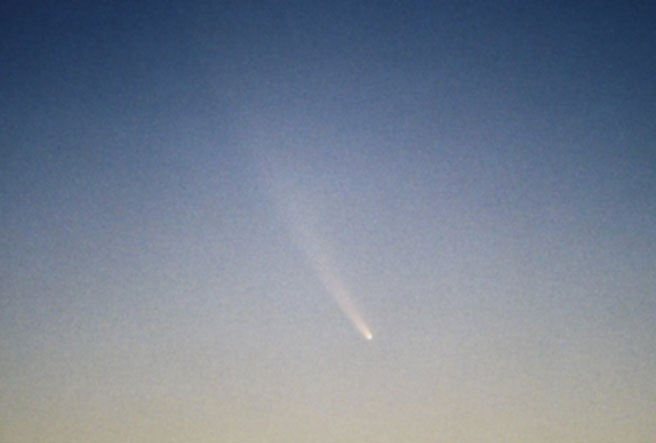
Comet McNaught visible in daylight, January 20, 2007.
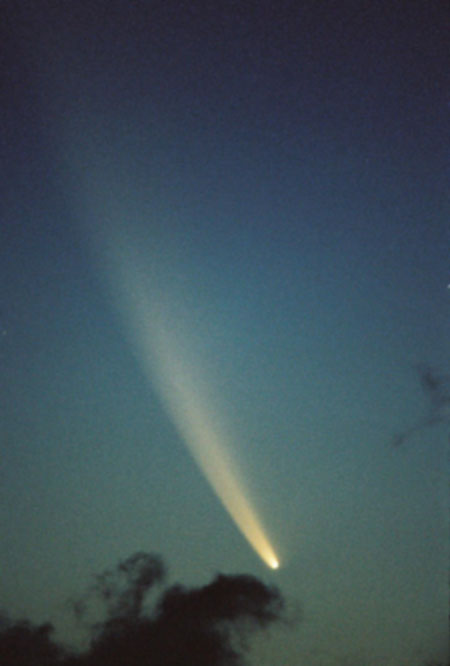
Comet McNaught became clearly visible during twilight.
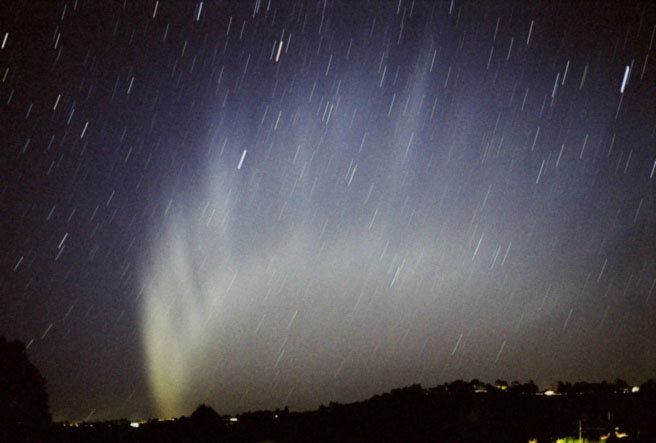
There are over a dozen synchronic
bands or streamers visible in Comet McNaught's tail
in this photograph.
The lights on the skyline are private homes built on Kureelpa Falls Road, on the edge of the Highworth
Range escarpment. The Dulong Lookout is at the left margin. Taken from Starfield Observatory
with a
standard lens which has a field width of 43 degrees. For more comet
images, click here:
Picture Gallery.
Dateline - 1 March 2020 - A 'mini Moon' is now orbiting the Earth
Astronomers say that the Earth's gravity has drawn in a tiny asteroid and temporarily pulled it into orbit around us, in a phenomenon that has only been recorded once before. The object was discovered by two astronomers working on a NASA-funded project in Arizona. It is a carbonaceous rock between 2 and 3,5 metres across, and at magnitude 20 it is very faint and too small to be seen with amateur telescopes. The asteroid's orbit indicates that it is temporarily bound to the Earth. It was officially announced by the International Astronomical Union's Minor Planet Centre (MPC) and named 2020 CD3. The asteroid is called a 'mini-moon' by some astronomers but the MPC prefers to call it a 'temporarily captured object' (TCO). It has been there for three years and takes 377.8 days to complete each orbit, but may escape from the Earth in the next few months. No evidence of perturbations due to solar radiation pressure is seen, and no link to a known artificial object has been found.
The object was discovered by Kacper Wierzchos and Theodore Pruyne, researchers at the Catalina Sky Survey (CSS), funded by NASA. They used a 1.52-metre telescope at the Mount Lemmon Observatory near Tucson, Arizona on February 15. The CSS helps NASA track near-Earth objects that could be potentially hazardous to the Earth. More information is available here . (Contributed by Mark and Bernie)
Dateline - 24 February 2020 - Betelgeuse is brightening again
Call off the supernova watch - Betelgeuse is brightening again. New data
from the American Association of Variable Star Observers (AAVSO) show that
the unstable red supergiant is bouncing back from its unprecedented decline.
The mystery of Betelgeuse's behaviour is not yet solved, however. Get the
full story on
Spaceweather .
Dateline - 14 February 2020 - The changing shape of Betelgeuse
Betelgeuse isn't just dimming, it's also changing shape. New images of the unstable red supergiant released today by the European Southern Observatory reveal a distinctly lopsided star. Is Betelgeuse about to blow? The images suggest another explanation. Visit today's edition of Spaceweather for the full story.
Dateline - 14 February 2020 - The fading of
Betelgeuse is now apparent to the naked eye
Observations from Nambour show that the star Alpha Orionis (Belelgeuse), normal magnitude 0.5, has faded to such an extent that its dimness is obvious to the naked eye. Whereas it was the second-brightest star in the constellation of Orion after Rigel (Beta Orionis), magnitude 0.13, it is now fainter than the nearby star Bellatrix (Gamma Orionis), magnitude 1.64.
Dateline - 9 February 2020 - A day of reckoning for Betelgeuse ?
Astronomers have been keeping a wary eye on Betelgeuse, the bright red star
in Orion's shoulder. All of a sudden, Betelgeuse isn't bright anymore - a
sign that the star could be on the verge of supernova. A new analysis by
astronomers at Villanova University shows that February 21 could be a key
date for the unstable supergiant. Visit today's edition of
Spaceweather
to find out what might happen later this month. See also
Dateline - 10 January 2020
below.
Dateline - 20 January 2020 - Australian meteorite contains particles which are the oldest ever found on Earth
The Murchison meteorite is one of the most studied meteorites due to its mass (over 100 kg) and the fact that it was an observed fall. It fell in Australia in 1969 near the village of Murchison near Shepparton in Victoria, and belongs to a group of meteorites rich in organic compounds.
In January 2020, astronomers reported that the oldest material found on Earth to date is the silicon carbide particles from the Murchison meteorite, which have been determined to be 7 billion years old, about 2.5 billion years older than the 4.54-billion-year age of the Earth and the Solar System. Click here for more.
Dateline - 16 January 2020 - Magnetic explosions on Earth's doorstep?
A type of explosion in space called a 'magnetic reconnection' can happen much closer to Earth than previously thought. That's the conclusion of researchers who published their findings in the January 13 issue of Nature Physics. The paper examines a powerful near-Earth reconnection event in December 2015 that delivered 20 times the energy of a magnitude 7 earthquake to 'the doorstep of Earth'. Visit today's edition of Spaceweather for the full story.
Dateline - 13 January 2020 - The Sun swallows a comet
Today, the Solar and Heliospheric Observatory
(SOHO) discovered the first comet of the new decade. Hours later it
was gone, destroyed by the Sun. Visit today's edition of
Spaceweather
for the full story and a video of the comet's death plunge.
Dateline - 10 January 2020 - The star Betelgeuse is "fainting"
Red supergiant star Betelgeuse (Alpha Orionis) is
on the verge of going supernova. An episode of "fainting" widely reported in
December has intensified in January, according to new measurements by
astronomers at Villanova University in Pennsylvania, USA. "Fainting" or
"dimming" is the opposite of "brightening", and over the past year
Betelgeuse has dropped nearly one full magnitude, from 0.5 to 1.4. Such a reduction
in brightness is easy to see with the unaided eye, and Betelgeuse has fallen
in ranking from being the 10th brightest star to the 21st. With supergiant
stars, such fainting can lead to a supernova outburst, when the star
collapses in on itself and then explodes violently. As Betelgeuse is only
640 light-years from Earth, such an explosion would appear to us as bright
as the Full Moon. Visit today's edition of
Spaceweather
for the full story of what could turn into the biggest astronomical event of
our lifetimes.
Dateline - 29 December 2019 - Crescent Moon just above Venus this evening
As darkness falls tonight, look above the west-south-western horizon to see a beautiful, slender crescent Moon just 2.4º above the brilliant planet Venus.
Dateline - 23 November 2019 - Starlink satellites meet a meteor shower
Astronomers monitoring the skies for an outburst of Alpha Monocerotid meteors on November 22 were surprised when their cameras recorded instead an outburst of satellites. A train of Starlink satellites flew over the La Palma Observatory in the Canary islands, stealing the show. Despite the interference, a flurry of Alpha Monocerotids was observed. Visit Spaceweather for the full story and video.
Dateline - 22 November 2019 - Spectacular gathering of planets this week
Planets are gathering in the sunset sky this week. Venus and Jupiter will converge for a beautiful conjunction above the west-south-western horizon this weekend (1.4 degrees apart on November 24) with fainter Saturn a handspan above the other two. Then, a slender crescent Moon will join them on November 28, just underneath Jupiter. The following night, the Moon will be midway between Venus and Saturn, and on November 30 the three planets and Moon will be lined up: from the top, Moon, Saturn, Venus, Jupiter. Venus will move up to be level with Saturn on December 10 and 11.
Dateline - 21 November 2019 - "Night Butterflies" over Norway
Earth is entering a stream of fast-moving solar wind. First contact on November 20 produced a visually stunning episode of aurorae
around the Arctic Circle - including "night butterflies" over Norway. NOAA forecasters say there is a chance of G1-class geomagnetic storms on November
22 as Earth moves deeper into the stream. If so, aurorae could appear in northern-tier US states such as Michigan and Minnesota. Check
Spaceweather
for updates and photos.
Dateline - 19 November 2019 - Meteor outburst could happen
this week
Get ready for a meteor outburst - maybe. Later this week, Earth will pass by a stream of dusty debris from an unnamed comet.
Forecasters believe this could cause an outburst of Alpha Monocerotid meteors between Thursday night and Saturday morning (November 21-23). Visit
today's edition of
Spaceweather
for the full story and observing tips.
Dateline - 13 November 2019 - STARLINK satellites are visible again
They're back. A new train of Starlink satellites is crossing the night sky following SpaceX's Monday launch of 60 more
internet-orbiters. Last night, multiple sky watchers in California saw the ensemble fly in formation over urban areas such as San Diego and Los
Angeles. You may be able to see them, too. Visit today's edition of
Spaceweather
for photos, video, and observing tips.
Dateline - 12 November 2019 - Transit of Mercury - the view from space
Yesterday, millions of people witnessed the tiny black form of Mercury crossing the disc of the sun. A just-released movie from
NASA's Solar Dynamics Observatory shows the transit as seen from more than 35 400 kilometres above the Earth - and it is amazing. To see the movie
and other out-of-this-world views (including a double transit of Mercury and the Hubble Space Telescope) visit today's edition of
Spaceweather .
Dateline - 4 November 2019 - Transit of Mercury next week
One of the biggest astronomy events of the year is just one week away: the Transit of Mercury. On Monday, November 12 (AEST), Mercury will pass directly in front the Sun, creating a jet black circular "sunspot" that anyone can observe with a small telescope, providing that they take the proper precautions with powerful filters to avoid permanent eye damage. Find out when and how to look on today's edition at Spaceweather . Note: this transit is not visible from Australia, as it occurs before the Sun rises.
Dateline - 28 October 2019 - Close encounter with a Gigantic Jet (lightning bolt)
A pilot flying over the Gulf of Mexico has had a rare close encounter with a Gigantic Jet. The exotic, towering plume of blue
lightning leapt up toward space only 60 kilometress from his aeroplane. Being alert, he video-recorded the bolt and, in the process, discovered
something surprising happening inside it. Get the full story at
Spaceweather .
Dateline - 23 October 2019 - Geomagnetic Storm Warning
A large hole in the Sun's atmosphere is facing Earth and directing a stream of solar wind towards us. Minor G1-class geomagnetic storms are likely when the gaseous material arrives on October 24 and 25. Sky watchers around the Arctic Circle can expect to see bright aurorae, with a slight chance for aurorae in Canada and northern Europe as well. Monitor Spaceweather for updates.
Dateline - 14 October 2019 - The toxic tail of Comet Borisov
For the first time, amateur astronomers are beginning to clearly see the tail of interstellar Comet Borisov, the first known active
comet from another star system. New measurements of gas in the tail show that 2I/Borisov is spewing cyanide - a possible clue to the nature of the
comet's faraway home. See also
Dateline - 12 September 2019 below for the initial report, and visit
Spaceweather
for the full story.
Dateline - 12 October 2019 - Soviet pioneer cosmonaut Alexei Leonov dies aged 85
Alexei (or Aleksey) Leonov was one of 20 Soviet Air Force pilots who were selected to be the first USSR team of cosmonauts in 1960. He conducted the very first 'space walk' from the space capsule Voskhod 2 in 1965 (it lasted for 12 minutes). He was expected and trained to be the first man on the Moon, but the Soviets cancelled their costly project after the Apollo 11 lunar lander Eagle with Neil Armstrong and Buzz Aldrin aboard got there first. Leonov commanded the Soviet crew in the Apollo-Soyuz project (a joint venture between the USA and the USSR) in 1975. In this project, an American Apollo capsule docked with a Soviet Soyuz one, forming the first (but temporary) international space station. The two crews were able to meet and shake hands with each other in space. Click here to see a televised meeting that took place 41 years later between Leonov and the American astronaut he shook hands with, Thomas Stafford.
Dateline - 1 October 2019 - A Green Flash on Venus
You've heard of green flashes on the Sun. But green flashes on Venus? They're real, and now is a good time to observe
them. Venus is just emerging from solar conjunction. This means that photographers observing Venus set over water (e.g. Moreton Bay) can capture
the rare flashes. Pictures of an actual green flash on Venus and observing tips are featured on today's edition of
Spaceweather .
Dateline - 26 September 2019 - Geomagnetic storm warning
A large hole in the Sun's atmosphere is facing Earth and directing a stream of solar wind in our direction. NOAA forecasters say
there is a chance of moderately-strong G2-class geomagnetic storms when the gaseous material arrives on September 28. The last such storm in early
September produced aurorae visible in many northern-hemisphere countries. Visit today's edition of
Spaceweather for
more information and forecasts.
Dateline - 12 September 2019 - A possible interstellar comet
A new comet just discovered by amateur astronomer Gennady
Borisov is rocketing through the solar system too fast for the Sun's gravity to hang onto it. Indeed, it appears to be a visitor from the stars.
Interstellar Comet Borisov will make its closest approach to the Sun and to Earth in December 2019. Today it is near the boundary between
the constellations Cancer and Lynx, and slowly coming south. It rises at the Sunshine Coast at about 4 am, but at magnitude 18 requires a professional
telescope to detect. Get the full story and observing tips on today's edition of
Spaceweather .
Dateline - 5 September 2019 - The return of STEVE
Last weekend polar skies lit up brightly in response to a geomagnetic storm. But not all the lights in the sky were aurorae. STEVE ("Strong Thermal Emission Velocity Enhancement")was there, too. Purple ribbons of non-auroral light arced over many locations in Canada and the United States. New research explains what powers STEVE and why it appears alongside the mysterious "green picket fence." Get the full story on today's edition of Spaceweather (and see also Dateline - 11 April 2018 below).
Dateline - 31 August 2019 - Geomagnetic storm in progress
A solar wind stream blowing faster than 700 km/s lashed Earth's magnetic field on August 31. This has sparked a G2-class (moderately strong) geomagnetic storm. So far auroras have been observed in Iceland, Alaska, Finland, Wisconsin and Michigan - with more expected tonight if the storm continues. Visit Spaceweather for photos and updates.
Dateline - 30 August 2019 - A "super sprite" over China
This week in China, a photographer captured a rare photo of a "super sprite"
- a gigantic tentacled jet leaping up from a thunderstorm in the wake of
Typhoon White Deer. Remarkable for its high resolution and clarity, his
photo is one of the best examples of Gigantic Jets ever recorded. Could
Solar Minimum be promoting this phenonemon? Visit
Spaceweather
for the full story.
Dateline - 29 August 2019 - Geomagnetic storm warning
A large hole in the sun's atmosphere is facing Earth, ejecting a stream of
solar wind in our direction. Minor (G1-class) geomagnetic storms are
possible as early as Aug. 31st when the gaseous material arrives. This is
the same large hole that targeted Earth in early August and caused auroras
to be visible in multiple northern-tier US States. Visit
Spaceweather
for updates.
Dateline - 27 August 2019 - Why are sunsets in the northern hemisphere turning purple ?
Around the northern hemisphere, sky watchers are noticing an unusual colour
in the sunset sky: purple. The hue ranges from soft violet to vivid magenta,
and is often accompanied by fine silvery streaks along the western horizon.
What's going on? The phenomenon is probably a result of two volcanoes, (one
in the Kuril Islands on June 22 and one in New Guinea on August 3) which
recently released sulphurous gases into the stratosphere. Get the full story
and observing tips at
Spaceweather .
Dateline - 24 August 2019 - Arctic Aurora season begins
Aurorae have returned to the Arctic Circle as the Midnight Sun finally
begins to fade. Sightings on August 23 and 24 confirm that green aurorae are
now mixing with polar twilight. This sets the stage for a good show on
August 27 when a high-speed stream of solar wind is expected to hit the
Earth's magnetic field, possibly sparking G1-class geomagnetic storms. Get
the full story on
Spaceweather .
Dateline - 15 August 2019 - Amazing video of sprites
A photographer in Europe has captured high-definition video of a sprite
storm over Italy. The images show a sprite's anatomy in rare detail, with
enormous tentacles dangling tens of kilometres down to the thunderstorm
below, dotted by balls of light the size of football fields. See the video
and learn more about sprites on today's edition of
Spaceweather .
Dateline - 12 August 2019 - Perseid meteor shower is under way
The Perseid meteor shower is peaking as Earth moves through the debris trail
of parent Comet Swift Tuttle. Last night (August 12-13), NASA meteor cameras
recorded more than 76 Perseid fireballs over the USA, with an even greater
number expected tonight (August 13-14). When's the best time to look? Visit
today's edition of
Spaceweather
for observing tips, live webcasts, and more.
Dateline - 12 August 2019 - Happy 100th birthday, Margaret Burbidge
Today Margaret Burbidge, one of the 20th century's greatest astronomers, celebrates 100 years of riding on planet Earth.
In 1957 Margaret Burbidge (born in England in 1919), her husband Geoffrey Burbidge (1925-2010), William Fowler (1911-1995) and Fred Hoyle (1915-2001) presented a detailed theory showing how the stars could produce all the known elements lighter than iron by normal fusion processes in concentric stellar layers, the heaviest at the centre. In an influential paper Synthesis of the Elements in Stars, they showed how the cosmic abundances of essentially all elements except the lightest nuclides could be explained as the result of thermonuclear reactions in stellar interiors. The details were given of eight processes in nuclear physics by which elements could be synthesised. The complex paper, 108 pages long, was published in the October 1957 issue of the Reviews of Modern Physics. Soon dubbed the ‘B2FH
’ paper, it was immediately celebrated as a monumental contribution to our understanding of the history of matter. It is available on-line.B2FH also stated that, if the star were massive enough, the heaviest elements would be created in a further process. After building a core of iron which was very stable, the star’s fusion processes would suddenly stop as the nuclear fuel was exhausted. In a matter of minutes the star would collapse in on itself, and the outer layers would mix with the intensely hot temperatures and pressures in the iron core. The heavier nuclei would absorb more neutrons and thereby build up the heaviest elements, including radioactive ones such as uranium. The imploding material would rebound off the superdense sphere of neutrons at the core, and the star would explode as a nova or supernova. The blast would scatter the new elements into space, where they would later condense into other stars and planets. In the next generation of stars, these new elements would not take part in thermonuclear reactions, but radiation pressure would drive them out into the star’s atmosphere where their presence would be revealed by dark absorption lines in the star’s spectrum. Each new generation of stars would be more ‘metal-rich’ than the previous one. This conflicted with Gamow’s theory that all elements were created in the ‘Big Bang’, and supported Hoyle's ‘Steady State’ universe.
Margaret Burbidge is still interested in cosmological research as Professor Emeritus of Physics at the University of California at San Diego (UCSD), where she has worked since 1962. She has contributed to over 370 articles on astronomical research. Her most recent work is in the field of non-standard cosmologies such as ‘intrinsic redshift’.
Many happy returns of the day, Margaret.
Dateline - 31 July 2019 - Be alert for Perseid fireballs
Earth is entering a stream of debris from giant Comet Swift-Tuttle,
source of the annual Perseid meteor shower. Forecasters say the shower won't
peak until August 12-13, but already NASA cameras are catching Perseid
fireballs streaking over the USA. The Perseids produce more fireballs than
any other annual shower (largely due to the size of the parent comet) so
your chances of seeing one are good. Visit today's edition of
Spaceweather
for observing tips.
Dateline - 25 July 2019 - Small asteroid explodes over Canada
Material from the asteroid belt landed on Earth yesterday, July 24th, when a small space rock exploded over Ontario, Canada. The resulting fireball was a bright as a full Moon and probably scattered meteorites over the countryside near the town of Bancroft, Ontario. Now the hunt is on for samples of matter from beyond Mars. Visit today's edition of Spaceweather for the full story.
Dateline - 17 July 2019 - Cosmic Ray update - new results from the Moon
A NASA radiation sensor in orbit around the Moon has detected a doubling of cosmic rays, making 2019 one of the worst years of the Space Age for
astronauts to travel into deep space. What's going on up there? The solar cycle is to blame. Visit today's edition
of
Spaceweather
for the full story.
Dateline - 16 July 2019 - Partial lunar eclipse tomorrow morning
On Wednesday, July 17, the full Moon will pass through the shadow of our planet, plunging 65% of the lunar disk into darkness. This partial eclipse
will be visible from most of the world - almost everywhere except North America. Visit today's edition of
Spaceweather
Dateline - 11 July 2019 - Aurorae seen from the stratosphere
A solar wind stream hit Earth yesterday - and the timing couldn't have been better. NASA's Stratospheric Observatory for
Infrared Astronomy (SOFIA) had just taken off from New Zealand. Astronomers onboard the specially modified Boeing 747 got an eyeful of rare auroral
forms as they skimmed the bottom of the stratosphere over the Southern Ocean. Visit
Spaceweather
for the full story.
Dateline - 8 July 2019 - A reversed polarity sunspot
A reversed-polarity sunspot has broken through the surface of the sun - the second time this month this has happened. This latest "backwards
sunspot" could mark the official beginning of new Solar Cycle 25. Visit today's edition
of
Spaceweather
to learn more about sunspot AR2744 and the transition
between solar cycles.
Dateline - 5 July 2019 - New Zealand pulls out of the Square Kilometre Array consortium
The SKA is a global collaboration of nine countries which is aimed to provide answers to fundamental questions about the origin and evolution of the universe. Its headquarters are at Jodrell Bank Observatory of the University of Manchester in Cheshire, England. Of the eleven who officially joined the consortium in the beginning, eight are Member Countries (Australia, Canada, China, Italy, South Africa, Sweden, The Netherlands and the United Kingdom), and India is an Associate Member. Due to financial constraints, Germany withdrew from the consortium in August 2014. On 2 July 2019, New Zealand also announced its withdrawal. Click here for a report.
Dateline - 2 July 2019 - Solar eclipse in South America
As this alert is being written, a total eclipse of the sun is about to begin in South America. Here are some links to live
webcasts:
#1,
#2,
#3,
#4 in Spanish .
Dateline - 2 July 2019 - Sunspots from the next solar cycle
Solar Minimum won't last forever. How do we know? Because this week a cluster of small sunspots from the next solar cycle bubbled up to the
surface of the sun. The dark cores didn't last long, but they had the unmistakable magnetic signature of Solar Cycle 25. Visit today's edition of
Spaceweather
for more information.
Dateline - 28 June 2019 - Sunset solar eclipse in South America
Residents of Chile and Argentina are about to witness a rare total eclipse of the sun. Next week, on Tuesday July 2, the new Moon will pass across the solar disc, creating a black hole in the sky just before sunset in the two South American countries. The path of totality cuts across ESO's La Silla Observatory in Chile and barely misses the centre of Buenos Aires in Argentina. Visit Spaceweather for timetables, animated maps, and links to live webcasts of the event.
Dateline - 26 June 2019 - Anomalous noctilucent clouds over Paris
Dateline - 21 June 2019 - The Sun is very quiet
Dateline - 7 June 2019 - Must-see Jupiter movie
Dateline - 5 June 2019 - A daytime meteor shower is
underway
Dateline - 28 May 2019 - Starlink satellite flares
Dateline - 24 May 2019 - The Taurid meteoroid swarm is coming
Dateline - 14 May 2019 - Multiple CMEs are approaching
Earth
Dateline - 2 May 2019 - What are geomagnetic jerks ?
Dateline - 15 April 2019 - Sunspot radio bursts
Dateline - 13 April 2019 - Watch a sunspot crack up
Dateline - 11 April 2019 - Black hole photographed for
the first time
Dateline - 5 April 2019 - Space weather probes shatter
GPS record
Dateline - 28 March 2019 - Can humans sense
geomagnetic storms ?
Dateline - 21 March 2019 - Big Sunspot
Dateline - 20 March 2019 - Earth-directed solar flare
Dateline - 13 March 2019 - Neutron radiation detected
on commercial plane flights
Dateline - 1 March 2019 - A month without Sunspots
Dateline - 26 February 2019 - Geomagnetic storms this
week
Dateline - 14 February 2019 - The Sun is very active
at present
Dateline - 14 February 2019 - Mars rover
Opportunity's mission declared officially ended
Dateline - 5 February 2019 - Aurora Australis video
Cold-weather astrophotography pioneer Robert Schwarz has just released a new
video of Southern Lights dancing over the Amundsen-Scott South Pole Station,
taken over a period of fourteen winters. The short movie (just under 6
minutes long) is a must-see for anyone interested in aurorae and space
weather. It highlights the otherworldly effect of geomagnetic activity on
our planet's south polar skies with scenes unlike anywhere else on Earth.
The video is featured on today's edition o
Dateline - 29 January 2019 - Solar wind, incoming
Dateline - 22 January 2019 - A meteoroid slams into
the Moon
On the first night of northern summer, many Parisians were stunned when the midnight sky over the Eiffel Tower turned electric blue. It was the
glow of noctilucent clouds (NLCs). The same clouds appeared in the USA a few nights later near Las Vegas, Salt Lake City, and Los Angeles. New data from
NASA's satellite-based Microwave Limb Sounder explain these anomalous sightings: As June comes to an end, the mesosphere remains unusually wet at
middle latitudes, creating rare conditions for the formation of NLCs.
Visit
Spaceweather for data and observing tips.
On June 22, sensors operated by the Comprehensive Nuclear Test Ban Treaty Organisation detected an explosion south of Puerto Rico. It was not, however, a nuclear
bomb. A small asteroid entered Earth's atmosphere and exploded in the air like 3 to 5 kilotonnes of TNT. Weather satellites caught the space rock's
fragmentation. Movies and analysis are featured on today's edition of
Spaceweather .
The Sun has just passed 33 days without a sunspot, marking this the longest stretch of blank suns in the current solar cycle. This development is consistent with recent
predictions that the solar cycle will reach a minimum in 2019-2020, ultimately bouncing back for a new Solar Max in the years ahead.
Today's edition of
Spaceweather highlights a unique movie of the planet Jupiter. Based on images from nearly a dozen amateur astronomers
around the world, it shows the Great Red Spot, a storm system wider than Earth, apparently unraveling. The storm's sudden decay is happening as
Jupiter approaches Earth for a close encounter on June 12th. Visit
Spaceweather
for observing tips.
Radars in the northern hemisphere are pinging with activity as one of the strongest meteor showers of the year takes place in broad
daylight. The source of the shower is sungrazing Comet 96P/Machholz. Although the meteors are emerging from a radiant point near the glaring sun,
it may be possible to see a few of them before sunrise on June 7.
Visit
Spaceweather
for observing tips.
SpaceX's newly-launched train of Starlink satellites is doing something unexpected. Many of the 60 satellites are glinting in sunlight - that is, "flaring."
Sometimes the flashes of light rival the brightest stars in the night sky. Visit
Spaceweather
to find out how to catch the train and perhaps see the flares yourself.
Earth is about to have a close encounter with a meteoroid swarm. In late June 2019, the gravelly Taurid Swarm will make its closest post-perihelion
approach to our planet since 1975. There's growing evidence that the swarm may be hiding large objects such as the Tunguska impactor that levelled a
forest in Siberia in 1908. Astronomers plan to peer inside the swarm using large telescopes to find these hazards - if they exist. Visit
Spaceweather
for the full story.
Dateline - 21 May 2019 - Is Jupiter's Great Red Spot
unravelling ?
Amateur astronomers are reporting a strange phenomenon on the verge of Jupiter's Great Red Spot. The giant storm appears to be unravelling. Long
streamers of deep-red gas are spooling away from the edge of the maelstrom. These streamers are becoming increasingly easy to see as Jupiter approaches
Earth for a close encounter next month. Visit
Spaceweather
for the full story.
NOAA forecasters say there is a 55% to 60% chance of geomagnetic storms on May 15
to 17 when a series of coronal mass ejections (CMEs)
could hit Earth's magnetic field. Storm levels are expected to range between category G1 and G2. Visit
today's edition
of
Spaceweather
for the full story.
In the late 1970s, researchers realized something strange was happening to Earth's magnetic field. From time to time, without any gusts of
solar wind to cause it, global magnetic fields would "jerk," suddenly accelerating in one direction or another. A big jerk in 2014/2015 prompted
officials to update the World Magnetic Model years ahead of schedule. A new model of Earth's interior, just published in Nature Geoscience, may
explain this phenomenon, possibly solving a 40 year mystery. Get the full story on today's edition
of
Spaceweather
.
Massive sunspot AR2738 is sending bursts of radio energy toward
Earth strong enough to make audible noises in the loudspeakers of common
shortwave receivers. An amateur radio astronomer in New Mexico recorded
some of the bursts this weekend - and they sound like ocean surf. Visit
today's edition
of
Spaceweather
to hear the sounds and find out how you can detect them
in your own backyard.
This weekend, one of the largest sunspots in recent years is directly facing Earth. The behemoth is not producing strong flares, but it
is doing something rare and interesting. A canyon of light (called a 'light bridge') is opening inside the sunspot's dark core, presaging a possible
disruptive breakup. The scale of the spot makes it an easy target for amateur astronomers with properly-filtered backyard telescopes. Visit
today's edition
of
Spaceweather
to
learn more.
Click
We all use GPS - to find ourselves in the back country, to navigate to the grocery store, to locate lost pets. NASA's four MMS spacecraft recently used the same system
to locate themselves an astonishing 187 167 kilometres (116 252 miles) from Earth, almost halfway to the Moon. This shatters previous records and expectations of
how far away GPS can work. Visit today's edition of
Spaceweather
to find out how they did it.
New research published by neuroscientists at Caltech shows that sudden
changes in Earth's magnetic field affect human brainwaves - specifically,
depressing alpha waves associated with wakeful relaxation. This raises the
possibility that humans can sense geomagnetic storms. Learn more about the
link between human biology and space weather on today's edition of
Sunspot AR2736, which hurled a CME toward Earth yesterday, is growing larger
and crackling with C-class solar flares. The active region now sprawls
across more than 100 000 km of the solar disc and contains multiple dark
cores as large as Earth, making it one of the biggest sunspots in recent
years. Visit
A new and rapidly growing sunspot, AR2736, announced itself this morning
with a C4-class solar flare. The Earth-directed explosion sent minor waves
of ionisation rippling through Earth's upper atmosphere and caused a
shortwave radio "brownout" over parts of Europe and Africa. Moreover, the
explosion hurled a coronal mass ejection (CME) into space, which might
deliver a glancing blow to Earth's magnetic field later this week.
Visit
Want to experience space weather? Just step on board an airliner. Flying
above 30 000 feet (9144 metres) can expose passengers to potentially significant doses of
cosmic rays. We have just conducted a new survey of radiation on flights
over five continents and, using bubble chambers, have detected an abundance
of deep space neutrons. Learn more about this biologically effective form of
cosmic radiation on today's edition of
The Sun has just passed an entire calendar month with no sunspots. The last
time this happened, in August 2008, the sun was in the nadir of a
century-class Solar Minimum. The current stretch of blank suns shows that
Solar Minimum has returned, and it could be as deep as the last one.
Visit
A large hole in the Sun's atmosphere is facing Earth and sending a stream of solar wind in our direction. Minor G1-class geomagnetic storms are likely
when the gaseous material arrives on February 27 - 28. Solar wind speeds could top 500 km/s (1.1 million mph), sparking auroras around the Arctic
Circle and possibly even from latitude +45º north. Visit
Sunspot numbers remain very low as the Solar Minimum continues. Nevertheless, there is some big activity on the Sun today. Really big. NASA
satellites and amateur astronomers are monitoring a giant filament of magnetism jutting out from the edge of the solar disc. The glowing structure
is fully one-tenth of the Sun's diameter. Visit today's edition o
Exploration of Mars by spacecraft has unaccountably suffered from a high attrition rate, with 70%
of vehicles failing before completing their missions. Yet there have
also been spectacular successes, as with the Mars Rovers Spirit and Opportunity
which landed on the red planet in 2004.
The designed life expectancy of both rovers was 90 days and one kilometre,
for it had been expected that dust would accumulate on their solar panels
within a few months, preventing them from providing electricity. Serendipity
played a part, for it seems that regular whirlwinds kept the panels clean
and functioning normally. Although Spirit became stuck in
sand and went silent after 5.3 years on Mars, Opportunity continued moving about on the surface and beaming back signals
and pictures to Earth until 2018. But in mid-2018, "Oppy's" luck ran out. In June last year a severe planet-wide dust storm overtook the rover’s
location and its final touching message on June 10 was “My batteries are low and it’s getting dark.” After the storm, the batteries failed to recharge and although over
1000 attempts were made over the next eight months, communication with Oppy was never restored. On February 13, 2019, NASA declared Opportunity’s mission
at an end, after 14.3 years work and travelling 45 kilometres. A third
rover, Curiosity, arrived on Mars in 2012 and is now in its seventh
year of operation. It is nuclear-powered and does not
need solar panels. It was therefore unaffected by the dust storm and is working normally. The lander InSight touched down on Mars on
November 26, 2018 after the dust storm had abated. Like Opportunity, it generates electricity from solar panels, but unlike the rovers
has no wheels and is therefore fixed in position. Google "Opportunity rover"
for more.
Dateline - 9 February 2019 - Trans-Neptunian comet
approaches Earth
In only a few days, newly-discovered Comet Iwamoto will split the orbits of Earth and Mars, making a relatively close approach to
our planet visible through small telescopes. This is a rare visit. The comet comes from the realm of Extreme Trans-Neptunian Objects, a distant region of
the solar system inhabited by strange objects such as "Sedna" and "the Goblin." Get the full story on
The Northern Lights (Aurora Borealis) get a lot more publicity than
the Southern Lights (Aurora Australis) as they are seen by the populations
of Northern Europe, Russia, Canada and the USA. Yet the Southern Aurora is
just as spectacular (sometimes more so) but there are not many people living
in those far-south latitudes to report on them. However, they are regularly
seen in Tasmania, New Zealand, Chile and southern Argentina. Occasionally
they can be seen from Victoria, New South Wales, South Australia and South
Africa, but only during the winter months and in periods of strong solar
activity.
A large hole in the Sun's atmosphere is facing Earth and ejecting a
stream of solar wind in our direction. Polar geomagnetic storms are likely
when the gaseous material arrives on January 31 or February 1. We've seen
this hole before. Visit today's edition o
During yesterday's total lunar eclipse (not visible from Australia,
but listed in our
Dateline - 17 January 2019 - Earth's shifting
magnetic field
Earth's magnetic field is changing so quickly that researchers have
been forced to update to the World Magnetic Model ahead of schedule.
Developed by NOAA and the British Geological Survey, the model is widely
used for precision navigation of devices ranging from nuclear submarines to
the common smartphone. Your own phone may be affected. Find out how on
today's edition o
Dateline - 15 January 2019 - A collision in the
Asteroid Belt
Something violent just happened in the asteroid belt. Not far
beyond the orbit of Mars, asteroid 6478 Gault appears to have been
struck by another asteroid. The resulting stream of debris stretches more
than 400 000 kilometres, which is greater than the distance between Earth
and the Moon. Astronomers around the world are now monitoring the formerly
unremarkable asteroid to see what happens next. Get the full story on
today's edition o
Dateline - 10 January 2019 - Venus and Jupiter in conjunction
Venus and Jupiter are converging for a beautiful conjunction in Ophiuchus,
the unofficial "13th constellation of the zodiac." The two bright planets
are easy to see even from light-polluted urban areas and are being
photographed by many observers surrounded by the morning-glow of sunrise. At closest
approach on January 21-22, they will be only 2.5 degrees apart, and visible even from brightly-lit cities.
Visit today's edition o
Dateline - 2 January 2019 - Historic first images of
Ultima Thule
Scientists from NASA's New Horizons mission have released the first
detailed images of Ultima Thule, the most distant object ever explored. Its
remarkable appearance, consisting of two primitive spheres stuck together in
the middle, is unlike anything we've seen before. Visit today's edition
Dateline - 31 December 2018 - Watch the NASA spacecraft New Horizons fly by the Kuiper Belt Object Ultima Thule at 3:33 pm on January 1 and 2
NASA's New Horizons spacecraft is now only hours away from Ultima Thule, a mysterious elongated object in the distant Kuiper Belt. At 3:33 pm
AEST (Queensland time) on January 1 (today), New Horizons will swoop past Ultima Thule three times closer than it buzzed Pluto in 2015. Radio
signals and data acquisition from the encounter will take about 10 hours to reach Earth, so information and pictures from the flyby will not be received
until about 1:30 am on Tuesday, January 2 (our time). More information and links to live coverage are available on today's edition of
Dateline - 28 December 2018 - Spotless Sun sparks geomagnetic storm
Solar Minimum is in full swing. No sunspots? No problem. Last night the
spotless sun produced a G1-class geomagnetic storm with bright auroras
reported from Iceland to Alaska. More lights are in the offing as a stream
of solar wind is expected to buffet Earth's magnetic field for the next 24
to 48 hours. Get the full story from
Dateline - 25 December 2018 - Noctilucent clouds blanket Antarctica
In Antarctica, Christmas lights are electric blue. Noctilucent clouds
glowing with the azure color of an electrical discharge are swirling around
the South Pole, blanketing almost the entire frozen continent, according to
new images from NASA's AIM spacecraft. Visit today's edition
Dateline - 22 December 2018 - Is Ultima Thule surrounded by mini-Moons ?
Long range images have revealed something strange about Ultima
Thule, the distant Kuiper Belt Object that NASA's New Horizons spacecraft is
approaching for a New Year's Day flyby. Although it is almost certainly
irregular in shape, the brightness of Ultima Thule does not seem to change
as it rotates in sunlight. One possible explanation: A swarm of
'mini-moons' surrounding it. Visit today's edition
Dateline - 18 December 2018 - The mystery of Ultima Thule
NASA's New Horizons spacecraft is about to make history - again. The
distant probe is less than two weeks away from "Ultima Thule," a strangely
elongated object in the distant reaches of the solar system. On New Year's
Eve, New Horizons will fly past Ultima Thule three times closer than it
buzzed Pluto in July 2015, giving scientists their first close-up look at a
small Kuiper Belt Object. Visit today's
Dateline - 12 December 2018 - Comet 46/P Wirtanen at perihelion today
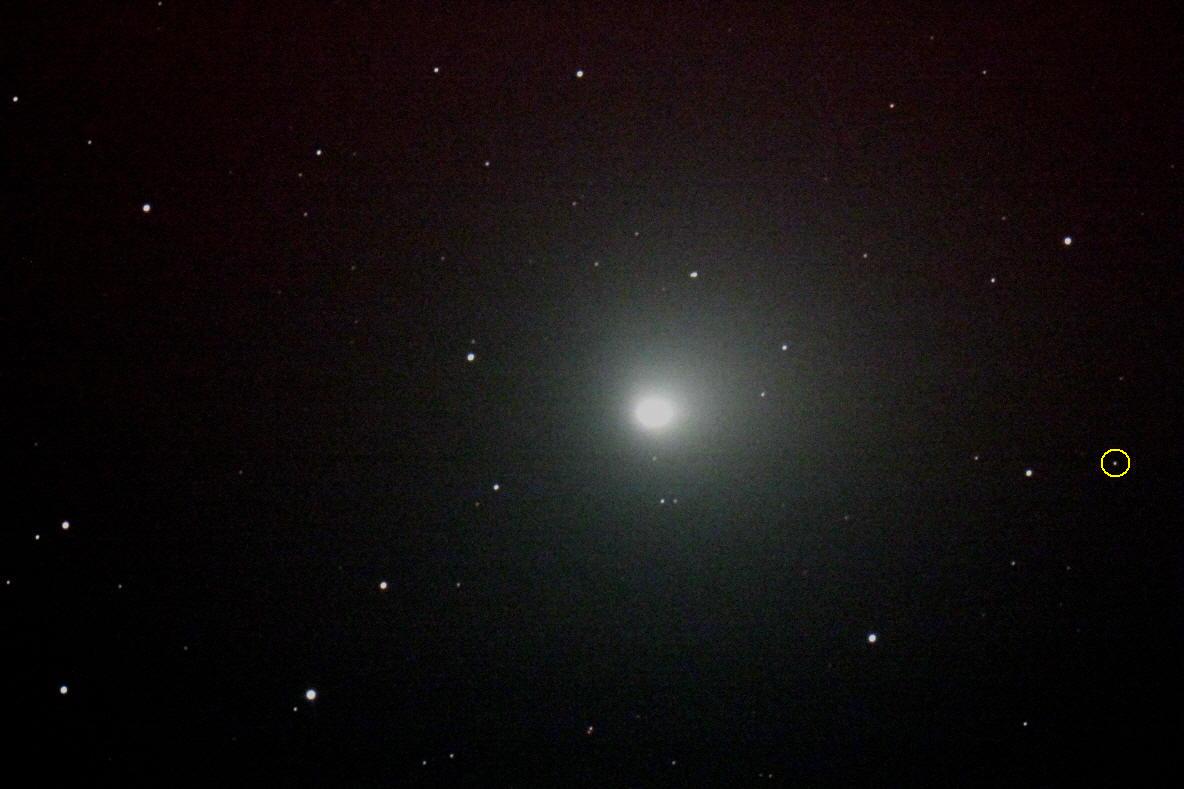
Dateline - 11 December 2018 - A Geminid meteor disintegrates next to Comet 46/P Wirtanen
The annual Geminid meteor shower is underway as Earth enters a stream of
gravelly debris from 'rock comet' 3200 Phaethon. The peak night is expected to
occur on December 14-15 with 60+ meteors per hour. Last night, a photographer
in Missouri caught an early Geminid disintegrating next to approaching Comet
46P/Wirtanen - a scene that could be repeated many times in the nights ahead.
The video and observing tips are highlighted in today's edition of
Dateline - 10 December 2018 - Voyager 2 enters interstellar space
Today at the American Geophysical Union meeting in Washington, NASA
announced that Voyager 2 has exited the sun's magnetic bubble and
entered interstellar space. The 70s-era probe is now experiencing a blizzard
of galactic cosmic rays as it charts the unexplored space between the stars.
See the data and learn more on today's edition o
Dateline - 7 December 2018 - China's mission to the far side of the Moon
China is going where no one has gone before, to the far side of the Moon.
Today, a Long March 3B rocket is scheduled to blast off from the
Xichang Satellite Launch Centre, propelling a lander and rover toward
craters hidden from Earth that may possibly contain water and other
resources. This would be important for future human exploration pf the far
side. If the mission succeeds, it will catapult China into the forefront of
lunar exploration with a landing that no other nation has yet attempted.
Visit today's edition o
Dateline - 4 December 2018 - A comet as big as the Full Moon approaches Earth
Hyperactive Comet 46P/Wirtanen is approaching Earth for one of the
closest Earth-comet encounters of the Space Age. Observers report that the
comet's gaseous green atmosphere now covers a patch of sky as large as the
full Moon, and it is growing larger. Of course, the solid nucleus of
the comet is much smaller, only 1.2 km across. Current predictions are that
it will reach magnitude 3.9 on December 15, which means that will appear as
a large, faint cloud about a degree across in the constellation of Taurus,
near the Hyades and Pleiades star clusters. As this date coincides with a
First Quarter Moon, the best way to observe this comet will be with
binoculars or small telescope taken to a dark site well away from city
lights, and observations made around midnight. Comet Wirtanen
presents no danger to the Earth. Sky maps and expert observing tips are
featured on today's edition o
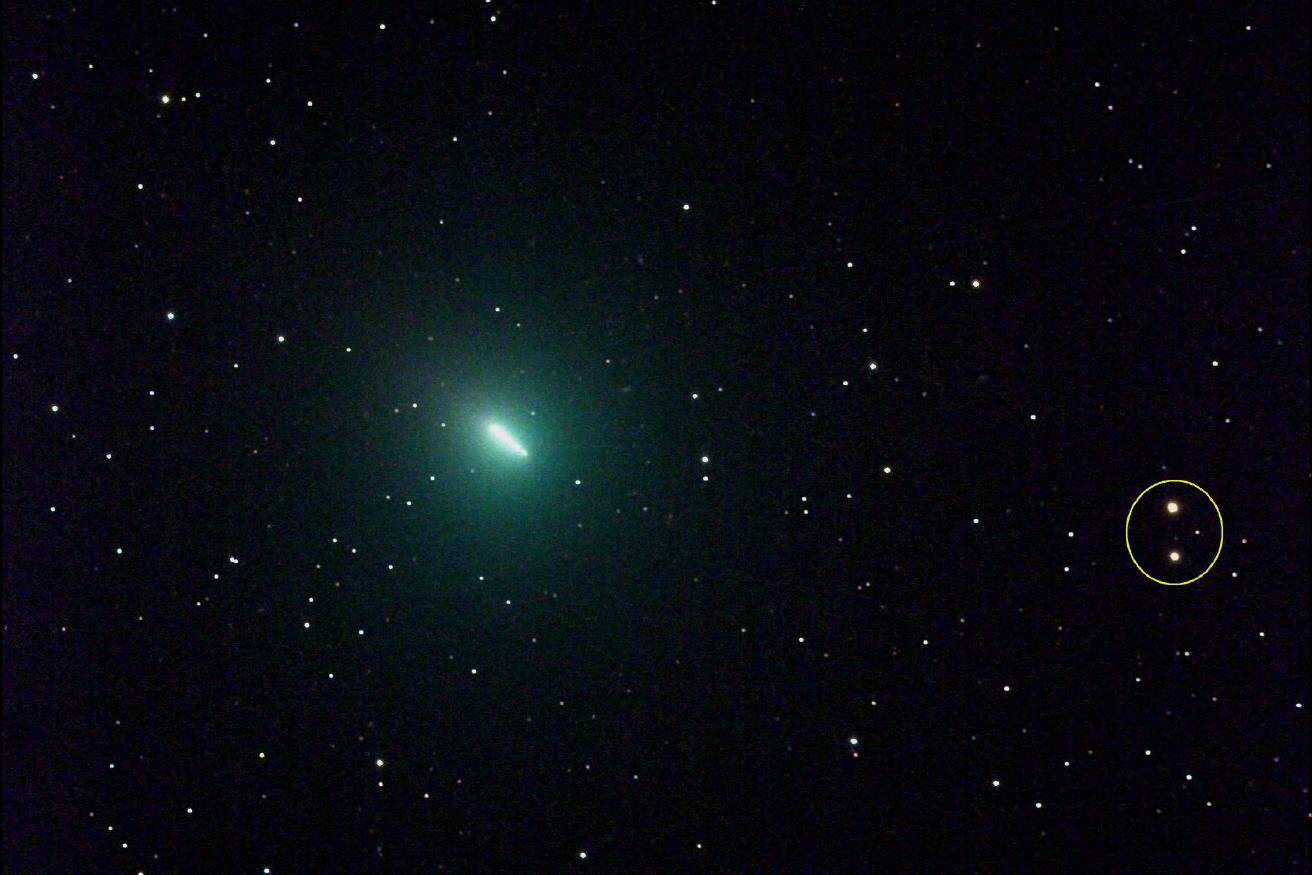
Comet 46/P Wirtanen on November 30, 2018. This image is a stack of five exposures between 8:13 and 9:05 pm. The comet's movement over the 52 minute period can be seen, the five images of the comet merging into a short streak. It is heading towards the upper left corner of the image, and is brightening as it approaches the Sun, with perihelion occurring on December 12. The images of the stars in the five exposures overlap each other precisely. The length of the streak indicates that the comet is presently moving against the starry background at 1.6º per day. The comet at 9:05 pm was at Right Ascension = 2 hrs 32 min 56 secs, Declination = 20º 27' 20". The upper star in the yellow circle is SAO 167833, magnitude 8.31, the same one circled in the picture below but with higher magnification.
Dateline - 28 November 2018 - A hyperactive comet approaches Earth
A small but hyperactive comet named "46P/Wirtanen" is nearing Earth for one of the 10 closest approaches by any comet of the Space Age. Wirtanen's emerald green atmosphere is now larger than the full Moon, and it is an increasingly easy target for binoculars and small telescopes. Currently at magnitude 6, naked-eye viewing could be just around the corner. It will reach its closest to the Sun (perihelion) on December 12, and then head in our direction. It will pass the Earth at a distance of 11.5 million kilometres (30 times as far away as the Moon) on December 16. In the week preceding, it will be at its brightest. On the night of November 29-30, it will be near the sixth magnitude star SAO 167839, which lies near the junction of the constellations Cetus, Eridanus and Fornax. It will be 4.3 degrees north of the zenith at 9:50 pm. The comet will therefore be visible for most of the night. In the coming weeks it will head rapidly north-north-east, passing 4.7 degrees east of the second magnitude star Menkar and crossing into Taurus on December 11. It will pass between the Pleiades and Hyades star clusters on the night of December 19-20, heading towards the star Capella in Auriga, which it will pass on December 24-25. This could be an exceptional flyby. Visit Spaceweather and here for more information and charts.
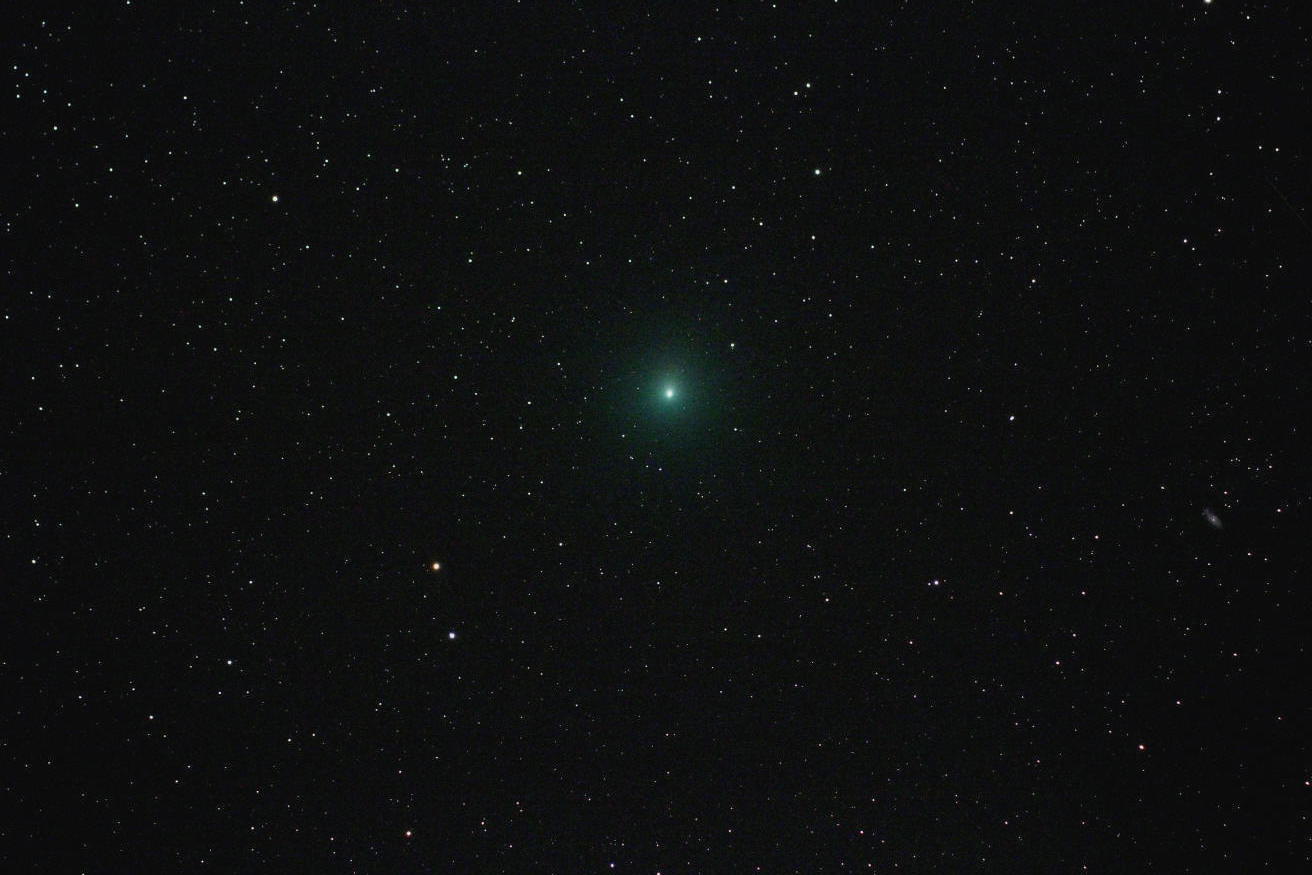
Declination = 21º 43' 13". The nearest star to the comet's position, just to its left, is GSC 5862:549, magnitude 14.1. The spiral galaxy near the right margin is
NGC 908.
Dateline - 27 November 2018 - NASA's MARS InSight mission successfully touches down on the red planet
InSight landed on Mars on November 27, 2018 at 5:52:59 am, Australian Eastern Standard Time (Queensland time). The entry, descent, and landing (EDL) phase began when the spacecraft reached the Martian atmosphere, about 128 kilometres above the surface, and ended with the lander safe and sound on the surface of Mars six minutes later. For InSight, this phase included a combination of technologies inherited from past NASA Mars missions such as NASA’s Phoenix Mars Lander. This landing system weighed less than the airbags used for the twin rovers or the skycrane used by the Mars Science Laboratory. The lean landing hardware helped InSight place a higher ratio of science instruments to total launch mass on the surface of Mars.
For more information see the
NASA report or the
ABC News coverage.
Dateline - 16 November 2018 - The Leonid meteor shower on
this weekend (just before dawn)
Earth is entering a stream of debris from Comet 55P/Tempel-Tuttle,
source of the annual Leonid meteor shower. NASA cameras have already
detected a number of Leonid fireballs over the USA with peak rates expected
on their November 17 and 18. The weekend display is best seen at dawn
alongside a new comet and a conjunction between Venus and the brightest star
of Virgo (Spica). Visit
Spaceweather
for
the full story.
Dateline - 12 November 2018 - Bright new Comet C/2018 V1 Machholz-Fujikawa-Iwamoto discovered by amateur astronomers
In modern astronomy, most comets are found by large mountaintop telescopes photographing the skies under computer control. The photographs are scanned automatically to look for any new object that is not on the databases, such as an asteroid or comet. These on-going robotic surveys discover most new comets before they are bright enough for amateur astronomers to catch them. Surprisingly, three amateur astronomers (one in Arizona, two in Japan) have just discovered a bright new comet in the constellation Virgo that somehow escaped the notice of the automated surveys. This morning it was near the magnitude 2.9 star Porrima (Gamma Virginis), and heading east through the background stars. It will be near the magnitude 3.38 star Zeta Virginis on November 18. Named Comet Machholz-Fujikawa-Iwamoto after the three discoverers, it is plunging toward the Sun and could brighten to naked-eye visibility later this month. It will be at its closest approach to Earth on November 27 and closest approach to the Sun on December 4. The best time to observe it from November 13 to November 18 will be from 4 am to the first light of dawn, close to the due east horizon, and a little over half a handspan to the left of Venus. As the days go by and it becomes closer to the Sun, it will become lost in the solar glare. Visit today's edition of Spaceweather for the full story.
This is the 12th comet discovered by Don Machholz of Arizona, who is the world's most successful living visual comet hunter. He found his 11th comet in 2010. It took 746 hours searching over eight years to capture the latest one.
Dateline - 3 November 2018 - Leonids meteor swarm due in two weeks
The Leonids meteor shower is one of the richest swarms of the year. It
generally averages about one meteor every three minutes, but every 33 years
it is much richer than that, causing what is known as a 'meteor storm' with
about 1000 meteors being seen per hour. The last 'storm' occurred in 1998,
and the next will be in 2031. The Leonids will encounter the Earth in the
pre-dawn hours of
Meteoroids are small rocky or metallic bodies in the Solar System, left over from the creation of the planets. Some are produced by impacts of asteroids with the Moon, Mars or other solid Solar System bodies. Their sizes range from about a metre to a grain of sand. If they are smaller than a sand grain they are called 'micrometeoroids' or 'space dust'. The Earth encounters thousands every day. They enter our atmosphere at a speed averaging 20 kilometres per second or 72000 kilometres per hour. Friction with our atmosphere burns them up immediately at an average height of 70 to 90 kilometres, producing a streak of light called a 'meteor' if they occur at night. Sometimes a faint trail of smoke persists for a minute or so. The resulting dust and ash floats down to the Earth's surface and settles on the ground. Much of our topsoil contains this interplanetary material. The Earth attracts about 40 tonnes of meteoric material every day. Large meteoroids may not burn completely away and can survive to hit the ground where they can be collected. Once they are on the ground they are called 'meteorites'. Two people were struck by meteorites in the last century - both survived the experience. Meteorites are not rare and most museums have a collection. There are usually small examples for sale on ebay.
Dateline - 1 November 2018 - Geomagnetic storm predicted this weekend
NASA's Solar Dynamics Observatory is monitoring a large hole in the
Sun's atmosphere, now directly facing Earth. A stream of solar wind escaping
from the opening is expected to reach our planet during the early hours of
November 4, possibly sparking minor G1-class geomagnetic storms over the
weekend. Visit
Spaceweather
for more information and updates.
Dateline - 19 October 2018 - Orionids meteor shower (meteors from Halley's Comet) has started
Right now, specks of dust from Halley's comet are disintegrating in Earth's atmosphere, kicking off the annual Orionid meteor shower. Forecasters expect the shower to peak this weekend with 20+ meteors per hour appearing to radiate from the constellation Orion. The nearly full Moon could reduce visibility, but it is possible to avoid the glare if you look at the right time. Visit today's edition of Spaceweather for sky maps and observing tips.
Dateline - 16 October 2018 - Coming in December, the year's best comet
Get ready for a very nice comet. In exactly two months, Comet 46P/Wirtanen will sweep past Earth, making one of the ten closest approaches of a comet to our planet since 1960. If forecasters are correct, Comet Wirtanen could become visible to the naked eye for weeks in this coming December. The small but unusually active comet will come closest to Earth just four days after its closest approach to the Sun, and it will be "up" all night long, making this an exceptional flyby. Visit Spaceweather for more information.
Dateline - 13 October 2018 - Draconid meteor outburst
On October 8-9, European sky watchers were amazed when a flurry of faint
meteors filled the sky at midnight. It was an outburst of the annual
Draconids meteor shower. Turns out, that outburst was just the tip of the
iceberg. Computer models show that Earth narrowly missed two streams of
comet debris that would have caused significant meteor storms had they
struck our planet. Visit
Spaceweather
for the full story.
Dateline - 10 October 2018 - Aurorae caught making noise
For centuries, people inside the Arctic Circle have reported hearing strange
hissing and popping sounds under the Northern Lights. Evidence is mounting
that at least some those auroral sounds are real. On October 7, a researcher
in southern Finland recorded some during a G1-class geomagnetic storm - the
latest in a series of detections by the long-running Auroral Acoustics
Project. Visit today's edition of
Spaceweather
to hear a sample "geomagnetic thunderclap."
Dateline - 28 September 2018 - The chill of the solar minimum
The sun is entering a deep Solar Minimum, and Earth's upper atmosphere is responding. Data from NASA's TIMED satellite show that the thermosphere (the uppermost layer of air around our planet) is cooling and shrinking, literally decreasing the radius of the atmosphere. If current trends continue, the thermosphere could set a Space Age record for cold in the months ahead. Visit today's edition of Spaceweather for the full story.
Dateline - 22 September 2018 - Japanese robots land on near-Earth asteroid
Yesterday, the Japanese space agency made history by landing a pair of robots on diamond-shaped asteroid Ryugu. The tiny explorers are now hopping across the space rock's rugged surface and sending unprecedented pictures back to Earth. Ryugu is a near-Earth asteroid that can approach our planet closer than the Moon, so exploring it is important. Learn more on today's edition of Spaceweather .
Dateline - 10 September 2018 - Green comet makes closest approach to Earth
Today, 11 September, Comet 21P/Giacobini-Zinner ("21P" for short) is making its closest approach to Earth in 72 years - only 58 million kilometres from our planet. The small but active comet is easy to see in small telescopes and binoculars shining like a 7th magnitude star in the constellation Auriga. It is visible low in the north-east in the hour before the first light of dawn appears. For observing tips and charts, visit Spaceweather . (The P in its name indicates that it is a periodic comet in an elliptical orbit around the Sun, i.e. one that makes regular appearances.)
Dateline - 10 September 2018 - Geomagnetic storm predicted
NOAA forecasters have issued a watch for G2-class (moderately strong)
geomagnetic storms on September 11 when a fast-moving stream of solar wind
is expected to hit Earth's magnetic field. During G2-class storms, aurorae
can appear in the southern Australian states and New Zealand. Visit
Spaceweather
for more information and updates.
Dateline - 25 August 2018 - A green comet approaches Earth
The beautiful green Comet 21P/Giacobini-Zinner is approaching Earth for a 58 million kilometre close encounter in early September, when it is expected to approach naked-eye visibility. This small but active comet is the parent of the annual Draconid meteor shower, a display that typically peaks on October 8, less than a month after the comet's 2018 flyby. Visit Spaceweather for more information about 21P and where to point your telescope as it approaches.
Dateline - 10 August 2018 - The Parker Solar Probe - a mission to touch the Sun
The Parker Solar Probe will help scientists learn more about the solar wind, an exotic brew of magnetic forces, plasma and particles. NASA has a ScienceCast Video on this topic.
Dateline - 9 August 2018 - Solar eclipse this weekend (not visible from Australia)
The Moon is about to take a bite out of the sun. On Saturday, August 11,
there will be a partial solar eclipse visible from locations around the
Arctic Circle and across much of Asia. During the 3+ hour event, as much as
73% of the solar disc will be covered. Visit
Spaceweather
for more information about this event.
Dateline - 6 August 2018 - Perseid meteor shower is underway
Earth is entering a stream of debris from giant comet
109P/Swift-Tuttle, parent of the annual Perseid meteor shower. Although the
shower is not expected to peak until next weekend, NASA all-sky cameras are
already detecting dozens of Perseid fireballs every night. This early
activity may be a good omen for the nights ahead, especially August 11-14
when the Earth is expected to pass through the densest part of the comet's
debris zone. Visit
Spaceweather
for more information and observing tips.
Dateline - 22 July 2018 - A large hole in the Sun's atmosphere
A large hole has opened in the sun's atmosphere and it is spewing a stream of solar wind toward Earth. NOAA forecasters estimate a
65% chance of minor geomagnetic storms when the gaseous material arrives on July 24th. Such holes are primary sources of solar activity during solar
minimum, both forming and staying open longer when sunspots are absent. Learn more on today's edition
of
Spaceweather .
Dateline - 13 July 2018 - A 'green flash' on Mars
Mars is approaching Earth for a 15-year close encounter
on July 27. The Red Planet is now so bright, it is experiencing forms of
atmospheric optics normally reserved for objects like the Sun and Moon.
Yesterday, an astronomer in Sweden watching Mars witnessed a rare green
flash. Visit today's edition of
Spaceweather
for a video of the phenomenon and more information about the martian
brightening.
Dateline - 9 July 2018 - Radiation hazards to airline passengers and crews from cosmic rays
On the heels of a new study showing that flight attendants have an elevated risk of cancer compared to the general population, a team including
representatives of Spaceweather.com and the students of Earth to Sky Calculus recently boarded a plane in
Los Angeles and flew to Brisbane carrying an array of cosmic ray
sensors. During their 13 hour flight across the South Pacific, the team detected secondary cosmic rays in the passenger compartment almost 40 times
stronger than on the ground below. Their "haul" of radiation included a significant number of neutrons captured in portable bubble chambers.
The radiation, which included x-rays and gamma rays, almost doubled over the
Coral Sea and the approaches to Brisbane. Read
today's edition of
Spaceweather
for the full story.
Dateline - 4 July 2018 - Approaching green comet explodes
A comet that could become visible to the naked eye in August has exploded in brightness, suddenly increasing its luminosity 16-fold. Whatever happened on Comet PANSTARRS (C/2017 S3) on July 1 has given it an expanding green atmosphere almost twice the size of the planet Jupiter. Visit today's edition of Spaceweather and later entries for pictures and more information about this approaching comet.
Dateline - 2 July 2018 - Planet-encircling dust storm on
Mars
A martian dust storm that started in late May, silencing
NASA's Opportunity rover, has now wrapped itself around the entirety of Mars, radically transforming the appearance of the Red Planet. Amateur
astronomers are taking pictures of the storm through backyard telescopes, and even naked-eye observers say they can see changes in the planet's colour.
Visit today's edition
of
Spaceweather
for more information and animations.
Dateline - 20 June 2018 - Big sunspot alert
Yesterday, sunspot AR2715 did not exist. Today, it
sprawls across more than 60 000 kilometres of solar surface with a primary
dark core wider than the Earth. So far, the active region has not produced
any big flares, but this could change if its development proceeds apace.
Visit today's edition
of
Spaceweather
for a video of the sunspot's genesis and
information about how it fits into the Solar Minimum.
Dateline - 13 June 2018 - Huge dust storm on Mars
Yesterday, NASA lost contact with the Opportunity
Mars rover as a ferocious dust storm spreads around the Red Planet. Thick
dust has turned day into night at Opportunity's work site in
Perseverance Valley, blocking sunlight to the solar powered rover. Currently
on the verge of circumnavigating Mars, the storm is so large that amateur
astronomers can now see it through backyard telescopes. Visit today's
edition
of
Spaceweather
for an animation of the spreading storm and more
information.
Dateline - 8 June 2018 - Mars now is brighter than Sirius
Mars is approaching Earth for an almost once-in-a-generation close encounter in late July. This week, the brightness of Mars surpassed that of Sirius, making the Red Planet brighter than any star in the night sky. If you are outside at 9 pm, you can't help noticing Mars as a bright, orange, star-like object low to the east-south-eastern horizon, and the show is about to get much better. Visit today's edition of Spaceweather for the full story.
Dateline - 5 June 2018 - Small asteroid collides with Earth
A small asteroid hit Earth on Saturday, June 2, exploding in the atmosphere over Botswana before it could reach the ground. The Catalina Sky Survey in Arizona had discovered the space rock only hours earlier as it hurtled toward our planet from inside the orbit of the Moon. Sensors used to monitor rogue nuclear explosions detected the asteroid's detonation and estimated its strength to be about the same as 480 tonnes of TNT. Visit today's edition of Spaceweather for the full story.
Dateline - 14 May 2018 - Lost asteroid returns to Earth
Eight years ago, astronomers lost a near-Earth asteroid.
They just found it. The space rock, named 2010 WC9, is approaching
Earth for a close encounter on Tuesday, May 15. There's no danger of a
collision, but the ~100 metre wide asteroid will be near enough for amateur
astronomers to photograph. Visit today's
edition of
Spaceweather
for the full story.
Dateline - 11 May 2018 - Red airglow over the Atacama Desert
Last night, the normally dark skies of Chile's Atacama
Desert lit up with rippling bands of red light. It looked like the aurora
borealis, but it was not. A photographer recorded the unusual apparition of
red airglow, so bright that it outshined parts of the Milky Way.
Visit today's
edition of
Spaceweather
for photos and an explanation of this
phenomenon.
Dateline - 7 May 2018 - STEVE visits the USA
Over the weekend, a solar wind stream engulfed Earth,
sparking stronger-than-expected G2-class geomagnetic storms. At the peak of
the storms, STEVE appeared. The strange ribbon-like aurora travelled south
and was sighted in multiple US states. Visit today's
edition of
Spaceweather
to see
pictures and learn more about STEVE (see also
Dateline - 11 April 2018
below).
Dateline - 2 May 2018 - Sunspots vanishing faster than expected
So far in 2018, the Sun has been blank more than half the time. Whole weeks have gone by without a single sunspot. Although forecasters have been expecting sunspots to disappear with the approach of Solar Minimum, it is happening faster than predicted. Visit today's edition of Spaceweather to see the data and to find out what it means, here on Earth.
Dateline - 28 April 2018 - Special conjunction of the Moon and Jupiter
On the night of April 30 - May 1, (next Monday night), the Moon and Jupiter will converge in the constellation of Libra for a special conjunction. Jupiter is approaching Earth for a close encounter in early May, making the giant planet a little bigger and brighter than usual. On Monday night, April 30, the Full Moon will glide past the brightening gas giant. It adds up to a display of rare brilliance in the midnight sky. Visit Spaceweather for sky maps and more information.
Dateline - 15 April 2018 - Surprise asteroid flyby
With little warning, on Sunday, April 15, a "Tunguska-class" asteroid
about the size of a football field flew through the Earth-Moon system.
2018 GE3 was discovered just the day before as it plunged inward from
the asteroid belt. A quick-thinking amateur astronomer in Europe was able to
record a video of the asteroid as it flew by.
Visit today's edition
of
Spaceweather
to see the movie and to learn more about this surprise
visitor.
Dateline - 11 April 2018 - Rare video of STEVE
Last night in parts of Canada, dogs started barking at the midnight sky. The canines were responding to a bright purple ribbon of light - also known as "STEVE" ("Strong Thermal Emission Velocity Enhancement") The apparition, which occurred during a G1-class geomagnetic storm, was so long-lasting that at least one onlooker had time to capture rare video of the phenomenon. Visit today's edition of Spaceweather to see STEVE in motion.
Dateline - 11 April 2018 - Geomagnetic storm in progress
A minor G1-class geomagnetic storm is in progress on April 11th as Earth
moves through a high speed stream of solar wind. This is causing bright
auroras around the poles, with Northern Lights sighted as far south as the
Dakotas in the USA. The gaseous material is flowing from a wide hole in the
sun's atmosphere--so wide that the stream could continue to influence our
planet for the next two to three days. Visit
Spaceweather
for updates.
Dateline - 8 April 2018 - Space lightning over Europe
Red sprites (also known as "space lightning") are dancing over
thunderstorms in Europe. A dedicated observatory spotted the eerie red forms
shooting up toward the Pleiades on April 4, marking an unusually early
start to the northern summer season for sprites. Today's edition of
Spaceweather
explores the possibility
that this development is related to recent increases in galactic cosmic
rays.
Dateline - 26 March 2018 - Chinese Space Station to disintegrate
China's Tiangong-1 space station is about to return to Earth - as a
massive fireball. Low solar activity kept Tiangong-1 in orbit longer
than officials predicted, but it's finally coming down. The European Space
Agency says the 8-tonne craft should re-enter sometime between March 30 and
April 2, a window of uncertainty which will narrow in the days ahead. Visit
Spaceweather
for more information and ground tracks.
Dateline - 19 March 2018 - Surprise geomagnetic storm
On March 18, an unexpected crack opened in Earth's magnetic field, sparking a brief but potent G2-class geomagnetic storm. Bright aurorae ringed the Arctic Circle while, in Europe, the light show descended as far south as Germany. With the northern vernal equinox less than a day away, this is the time of year when such cracks tend to form. Today's edition of Spaceweather explains the phenomenon of magnetic cracks and how you can monitor them online.
Dateline - 15 March 2018 - Stephen Hawking has left us
World renowned physicist and cosmologist Stephen William Hawking has died peacefully at home in Cambridge at the age of 76. He was the first to unite Einstein's theory of relativity with quantum mechanics, to produce a new theory of cosmology which included black holes and relativistic effects. With the mathematician Roger Penrose, he proposed in 1970 that the universe began as a singularity. If he had been able to support his theories by performing practical observational work, he would have been certain to win a Nobel Prize in Physics. Hawking wrote several popular science books including the best-seller "A Brief History of Time".
At the age of 22, as a student at Cambridge University,
he was diagnosed with a rare form of motor-neurone disease and given only a
few years to live. The illness progressed slowly and left him wheel-chair
bound, and later almost completely paralysed. He was virtually unable to
speak and was forced to communicate via a voice synthesiser (using one cheek
muscle to operate a mobile computer). Yet he met two US Presidents, flew at
zero gravity in a special plane, and fathered three children, Lucy, Robert
and Tim, who said:
"We are deeply saddened that our beloved father passed away today. He
was a great scientist and an extraordinary man whose work and legacy will
live on for many years."
They praised his "courage and persistence" and said his "brilliance and
humour" inspired people across the world.
Dateline - 22 February 2018 - Earth's magnetic field is oscillating
This morning in Lofoten, Norway, a
magnetic observatory picked up unusually pure low-frequency waves rippling
around the Arctic Circle. Known as 'pulsations continuous (Pc)', these rare
magnetic oscillations can energise particles in our planet's magnetosphere,
boosting the brightness of aurorae. Indeed, strong auroras are being seen
right now in Scandinavia. Visit today's edition of Spaceweather
to learn what caused these Pc waves and to
monitor the ongoing display.
Dateline - 20 February 2018 - The roadster and the star cluster
How far away can you see a cherry red
Tesla Roadster? Yesterday, a telescope in Chile spotted Elon Musk's electric
car 3.7 million kilometres from Earth as it was passing by star cluster NGC
5694. Using orbital elements published by NASA, amateur astronomers are
setting new distance records almost every day as they track the Roadster en
route to the orbit of Mars. Visit today's edition of Spaceweather
for updates and a movie of the Roadster and the
star cluster.
Dateline - 19 February 2018 - Geomagnetic storm in progress
A G1-class geomagnetic storm is
underway on February 19 as Earth enters a stream of fast-moving solar wind.
G1-class storms are relatively minor and have little effect on satellites or
global power grids. However, they can spark bright auroras around the Arctic
Circle and confuse migratory animals that navigate using magnetism at high
latitudes. Visit Spaceweather
for more information and updates.
Dateline - 14 February 2018 - Sunspot explodes - hurls CME at Earth
On February 12, the magnetic canopy
of sunspot AR2699 exploded, for more than six hours. The slow-motion blast
produced a C1-class solar flare and hurled a coronal mass ejection (CME)
almost directly toward Earth. NOAA forecasters say there is a 60% chance of
minor G1-class geomagnetic storms with isolated periods of stronger G2
storming when the CME arrives on February 14 or 15. Visit Spaceweather
for more information about this event and the possible visibility of
aurorae.
Dateline - 9 February 2018 - Amateur astronomers photograph Tesla motor car in space:
"It's the craziest thing I've ever captured in my telescope," says amateur astronomer Raymond Kneip. Last night, he photographed Elon Musk's cherry red Roadster 430 000 kilometres from Earth, heading toward the orbit of Mars. NASA has just released an ephemeris (celestial co-ordinates) for the electric car, allowing astronomers to track and photograph the Tesla as it recedes into deep space. Pictures of the Roadster and instructions for accessing NASA's ephemeris may be found on today's edition of Spaceweather .
The first remarkable Space-X mission in which a rocket with two boosters was flown to the threshold of space can be viewed here . Both boosters detached and returned to Earth, landing simultaneously
in vertical positions, while the main rocket landed safely, also vertical, on a ship at sea. I kid you not.
Dateline - 5 February 2018 - A solar minimum sunspot:
With Solar Minimum right around the
corner, sunspot counts are at an almost ten year low. So it came as a
surprise yesterday when a relatively large sunspot emerged near the sun's
eastern limb. AR2699 has a primary dark core larger than the Earth with many
smaller magnetic condensations trailing behind it, in all stretching more
than 75 00 km across the sun's surface. Rare "solar minimum sunspots" are
capable of intense explosions just like sunspots during more active phases
of the solar cycle. Visit today's edition of
Spaceweather
for more information and updates.
Dateline - 26 January 2018 - A long-dead spacecraft wakes up:
In 2005, a NASA spacecraft named
IMAGE mysteriously went silent, abruptly ending a successful mission to
study Earth's magnetosphere. Thirteen years later, it's back. On January 20,
2018, an amateur astronomer in Canada picked up radio transmissions from
IMAGE, alive after all. The satellite may have been chattering away at
Earth for years unheard and unnoticed. Now NASA is working to regain contact
and possibly revive a key asset for space weather research and nowcasting.
Visit today's edition of
Spaceweather
for the full story.
Dateline - 14 January 2018 - Geomagnetic storm in progress:
A G1-class geomagnetic storm is underway on January 14 as Earth enters a stream of fast-moving solar wind. G1-class storms are relatively minor and have little effect on satellites or global power grids. However, they can confuse migratory animals that navigate using magnetism at high latitudes and, moreover, may spark bright aurorae around the Arctic Circle. Visit Spaceweather for more information and updates.
Dateline - 11 January 2018 - Blue comet PanSTARRS:
Beyond the orbit of Mars, an unusual blue comet is approaching the Sun. Every time astronomers look at Comet PanSTARRS (C/2016 R2), it has a different appearance. Daily images show gaseous jets waving wildly around the comet's core and dusty clouds billowing down the comet's tail. This hyperactivity comes despite the fact that the comet is located in a region of space where deep cold and feeble sunlight usually discourage such volatility. What's happening? The comet's blue colour is a crucial clue. Find the answer on today's edition of
